Clos de l’Arlot, Premier cru: This 5.44-hectare Premier Cru climat, located in the appellation of Nuits-St-Georges, is a a monopole of the Domaine de l’Arlot. It lies along the Beaune-Dijon road as it passes through the commune of Premeaux-Prissey immediately to the north of the Clos de la Marechale. Due to a geological fault, the slope of the land becomes quite steep, ranging from 10% to a dizzying 35%. Facing east, southeast and lying at 230-260m above sea level, the soil is a rich mixture of limestone and clay over a base of Comblanchien limestone. Unusually, this Nuits-St-Georges vineyard produces both red and white wine. There are 1.76 hectares devoted to Chardonnay and 2 hecatres to Pinot Noir. The vineyard takes its name from the tiny Arlot River, a tributary of the Courtavaux River.
Archive for the ‘Wine’ Category
Vineyard Description: Nuits-Saint-Georges, CLOS de l’ARLOT, Premier Cru
Posted in Appellations, Burgundy, Vineyards, Wine, tagged Domaine de l’Arlot on May 4, 2010| Leave a Comment »
Vineyard Description: Nuits-Saint-Georges, CLOS de la MARECHALE, Premier Cru
Posted in Appellations, Burgundy, Vineyards, Wine, tagged Domaine Jacques-Frédéric Mugnier, J-F. Mugnier on May 4, 2010| Leave a Comment »
Clos de la Marechale, Premier Cru: This 9.55-hectare Premier Cru climat of Nuits-Saint-Georges, is a monopole of Domaine J-F. Mugnier. The Clos is a walled vineyard that abuts the Beaune-Dijon road (RN 74) as it passes through the commune of Premeaux-Prissey at the southern extremity of the vineyards in the Nuits-St-Georges appellation. It has been owned by the Mugnier family since 1902 but was under lease to Maison Faiveley until 2004. The slope of the land is very gentle at 5-6%. Facing east, southeast and lying at 240-260 meters , the soil is a rich mixture of limestone, clay, pebbles and sand over a subsoil of pink Comblanchien limestone.
Almost the entirety of the vineyard is dedicated to the production of the iconic red Nuits-St.-Georges, Clos de la Marechale, made entirely from Pinot Noir. There is however, a tiny plot of 400 square meters, situated along the northern edge of the vineyard, which has been planted with Chardonnay, and produces one of the very few Premier Cru white Burgundies in the Côte-de-Nuits. Prior to 2004, wine from this unique plot had been reserved solely for the Faiveley family but is now available in very limited quantities.
It is occasionally claimed that the Clos de la Marechale derives its name from the wife of a Marechale of the Second Empire, during the time of Napoleon III. It must be emphasized, however, that Fred Mugnier, who has thoroughly researched the history, rejects this derivation and asserts that the origin of the name is unknown. Prior to its present name, the vineyard was known as the Clos des Forches, which is the name that Domaine Mugnier now uses for the wine made from younger vines.
Profile: Domaine COMTE GEORGES de VOGÜÉ
Posted in Burgundy, Domaines, tagged Burgundy, Chambolle-Musigny, Comte Georges de Vogue, Domaine de Vogue, Georges de Vogue on May 3, 2010| Leave a Comment »
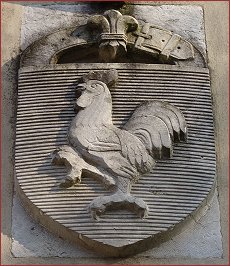 It is entirely appropriate that the rooster is the symbol at once of France and of the Domaine Comte Georges de Vogüé, so inextricably are the two bound together in history and tradition. The Domaine de Vogüé is one of the few iconic wine properties in France, with a transcendent reputation for quality that intrigues every epicure who has ever popped a cork or sniffed the bouquet of pedigreed Pinot Noir from Burgundy.
The roots of the Vogüé family in Chambolle reach back to 1450, and to a long line of aristocrats who have since served as faithful stewards of some of the finest vineyards in the world. The modern history of the Domaine commenced just after the Second War with the revival of the French economy and the vineyards in Burgundy. Presiding over the Domaine during this period was the larger-than-life, Hemmingway-esque Comte Georges de Vogüé, who

Comte Georges
personally led the renaissance with charm, passion and resolute skill. Today the pipette has passed to the Count’s granddaughters, Claire de Causans and Marie de Ladoucette, who have ably directed the affairs of the Domaine through their continued confidence in estate manager Jean-Luc Pépin, winemaker Francois Millet, and vineyard manager Eric Bourgogne.
Domaine Comte Georges de Vogüé, from its base in Chambolle-Musigny, is currently comprised of 12.52 hectares of some of the finest vineyards in the Côte d’Or, including 7.12 hectares (almost 70%) of the Grand Cru Musigny , 2.6 hectares of the Grand Cru Bonnes Mares, a .60 hectare parcel of Premier Cru Les Amoureuses; and a parcel each of Premiers Crus Les Fuées and Les Baudes, together aggregating .34 hectares; and a 1.8 hecatre parcel of the villages-level lieu-dit Les Porlottes.
The Domaine owns 7.2 hectares of the Grand Cru Musigny including the entirety of the Les Petits Musignys climat of which .66 hectares are planted in chardonnay. This 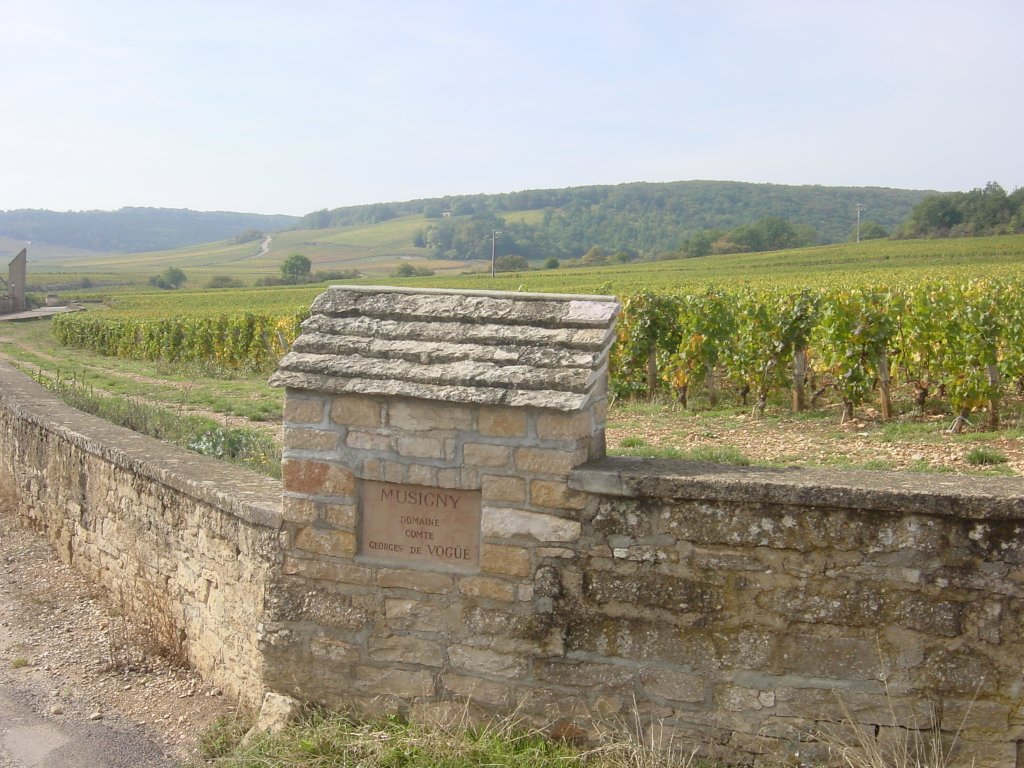 wine is entitled to the status Grand Cru Musigny Blanc, which would make it the only white Grand Cru in the Côte de Nuits. At present, however, mostly due to the youth of the vines, the Domaine has elected to bottle this wine (about 150 cases per year) only as Bougogne blanc. For similar reasons, the Domaine chooses to declassify approximately 2.8 hectares of vines (those younger than 25 years) within Musigny, and to bottle this wine (approximately 600 cases per year) as Chambolle-Musigny Premier Cru. This leaves 3.66 hectares of vines in Musigny, averaging 40 years, that create the Domaine’s iconic Musigny, Vieilles Vignes. Only about 900 cases are made annually. The parcel of Bonnes Mares owned by the Domaine is situated entirely in the Chambolle portion of the climat, close to the village itself. At 2.7 hectares, it is the largest single parcel of the climat and amounts to almost 20% of the entirety. The vines were planted in 1970 and yield only about 500 cases a year. The small parcel (.60 hectares) of the Domaine’s Les Amoureuses is located in the uphill, easternmost section of the climat, separated from Musigny only by a small. The vines here were planted in 1970 and yield about 165 cases per year. The Domaine’s villages-level Chambolle-Musigny, of which about 400 bottles are produced each vintage, derives mainly from a 1.8 hectare plot in the climat of Les Porlottes. Situated near the wooded area to the west of the village, the rocky, limestone soil in Les Porlottes contains vines planted in 1975. The Domaine’s .34 hectares of Premiers Crus Les Baudes (planted in 1955) and Les Fuées (planted in 1964) are declassified and included within the villages-level cuvée.
It is axiomatic to the Burgundian commitment to terroir that vineyard management is the most crucial element in making wine expressive of the vineyard and vintage. Vineyard manager Eric Bourgogne, who succeeded Gérard Gaudeau in 1996, is a practitioner of lutte raisonnée, a system of vine cultivation that is essentially organic and noninterventionist. Lutte raisonnée entails holistic and balanced viticultural management with primary focus on microbial health of the soil and the biodiversity of the vineyard. The governing policy is to support and maintain the natural ecosystem of the vineyard so that the vines can prosper without intervention, thereby naturally resisting pests and disease. The system pursues a reasoned and not absolutist approach, however, and practitioners of lutte raisonnée will occasionally permit limited chemical intervention if certain danger thresholds are passed, and when chemicals are viewed as less harmful to the soil than alternative biodynamic treatments. As a practical matter, lutte raisonnée can be distinguished from biodynamie in that the former implies the application of treatments only as a necessary response and the use of chemicals as a less harmful alternative; whereas biodynamie implements treatments systematically as prevention and employs biodynamic remedies like sulphur and copper that many vignerons believe are more harmful to the vineyard than chemical alternatives. Lutte raisonnée , in the judgment of its practitioners, thus results in less intervention and a flexible approach that elevates the long term health of the vineyard above organic and biodynamic orthodoxy.
Eric Bourgogne eschews chemical fertilizer, instead applying small amounts of compost made at the Domaine. Another tool that Eric Bourgogne employs in his vineyards is the seeding of the vineyard with insect pheromones in order to disrupt the mating activities of vineyard pest. This confusion sexuelle serves in lieu of insecticides and pesticides, which are shunned. The Domaine also controls predation by promoting competition among insects, believing that a natural balance of insects assures better prospects for vineyard health. Bourgogne also interplants grass between rows and allows it and concomitant weeds to grow during autumn and winter. The objective is to resist soil erosion and to challenge the vines. Horse plowing is employed in the spring as a means of avoiding the soil compaction caused by mechanical tractors.
It sometimes appears that winemaking requires simultaneously the technical skills of a proficient chemist and the artistic vision of a poet. If this be true, then Francois Millet is perfectly suited to the task, for his technical decisions

Winemaker Francois Millet
are as deliberately reasoned as they are informed by his intuitive connection to the ethereal. Fine winemakers today invariably and wisely refuse to follow formulaic winemaking, and insist on preserving a wide latitude of options depending on conditions. Francois Millet, however, elevates this flexible attitude to a higher plane of reality. He varies his winemaking based on vintage, vineyard and also by parcel and will seamlessly change direction if his finely honed nose so persuades him.
There remain, nonetheless, certain inclinations and preferences that may suggest Millet’s normative instincts. Destemming is favored, although the percentage will vary between 30% and 100% depending on vintage and parcel. The objective of retaining stems is to achieve an overall balance of tannins, according to Millet, and so he will vary the proportion of stems depending, for example, on the appellation, the quality of natural grape tannins in the vintage, and the soil of the particular parcel.
Generally, Millet favors a short period of natural pre-fermentation maceration. Fermentation temperatures are regulated to remain below 32°-33°C, although the length of the cuvaison, which can vary between two weeks and a month, varies depending on the vintage and the parcel. There is then, importantly, a period of post-fermentation maceration, after which the free-run wine is racked off. The remaining pulp is gently then pressed and segregated until careful evaluation confirms that the time is appropriate to add the press wine.
Not surprisingly, the Domaine maintains an adaptable policy toward new oak, generally using between 40% and 70% new oak depending on conditions. At present, Millet has decided that Allier oak is the most suitable for his barrels and so uses that exclusively. Obviously, the period of élevage varies according to the rate of the wine’s development, but generally the wines are bottled after between 18 and 20 months months’ aging. Fining, with egg whites or gelatin, may occasionally be used but filtration is employed only rarely.
Vineyard Description: Vosne-Romanée, LA COLOMBIÈRE
Posted in Appellations, Burgundy, Vineyards, Wine, tagged Domaine du Comte Liger-Belair, Liger-Belair, Louis-Michel Liger-Belair, Vosne-Romanée on April 26, 2010| Leave a Comment »
La Colombière is a lieu-dit located in the commune of Vosne-Romanée in Burgundy’s Cote d’Or. The vineyard lies just east of that portion of the village which abuts Grand Cru vineyard Romanée St-Vivant. La Colombière itself lies halfway between the RN74 and the village. The soil of La Colombière is similar to the clay and limestone of other village-level vineyards east of the town, such as the Clos du Château, but is significantly less rocky.
Major owners of La Colombière include Domaine du Comte-Liger-Belair, which exploits a .78-hectare parcel just to the east of the Domaine’s monopole, Clos du Château. The southeast-facing parcel is planted with vines averaging 60-80 years. Louis-Michel Liger-Belair uses 350-liter barrels for élevage of his La Colombière.
Vineyard Description: Vosne-Romanée, CLOS du CHATEAU, monopole
Posted in Appellations, Burgundy, Vineyards, Wine, tagged Comte Liger-Belair, Domaine du Comte Liger-Belair, Louis-Michel Liger-Belair, Vosne-Romanée on April 26, 2010| Leave a Comment »
Clos du Château is a small 0.83-hectare lieu-dit located in the commune of Vosne-Romanée in Burgundy’s Cote d’Or. The walled vineyard is a monopole of Domaine du Comte Liger-Belair, and adjoins the Château de Vosne-Romanée, where the Liger-Belair family lives and where the Domaine’s cuverie is located. The vines were planted in 1970 in the rocky, limestone soil of the vineyard. The vineyard produces approximately 325 cases of wine each year.
Appellation Profile: MUSIGNY, Grand Cru
Posted in Appellations, Burgundy, Vineyards, Wine, tagged Domaine de la Vougeraie, Domaine Jacques-Frédéric Mugnier, Domaine Leroy, Georges de Vogue, Georges Roumier, J-F. Mugnier, Vougeraie on April 23, 2010| 2 Comments »

Musigny is a Grand Cru vineyard and appellation situated in the commune of Chambolle-Musigny in the Côte de Nuits sector of Burgundy. The vineyard lies to the south of the village itself, and borders the Grand Cru Clos de Vougeot in the southeast, the Grand Cru Échezeaux in the south, and the Premier Cru Les Amoureuses in the northeast. The vineyard aggregates a modest 10.86 hectares and lies on a slope ranging from an 8% to a 14% grade, with elevations between 260 meters and 280 meters. The shallow brown topsoil, which averages only 20cm-30cm in depth, is comprised of limestone pebbles and red clay over a limestone base. Similar to Les Bonnes Mares, Musigny is bifurcated by a path into a northern section, Grand Musigny, and a southern section, Les Petits Musignys, which is a monopole of the Domaine Georges de Vogüé. Grand Musigny, which faces southeast, is mostly limestone with some clay. The southern section, Les Petits Musignys, faces south and is comprised of a higher proportion of clay. Musigny produces exclusively Pinot Noir-based red Burgundy, except for a tiny parcel of Les Petits Musignys from which Vogüé produces a precious white wine from Chardonnay, the only one in the Côte de Nuits entitled to be labelled as Grand Cru.
It is beyond dispute that Le Musigny is one of the greatest vineyards in the world. The name derives from a Gallo-Roman settlement, Musinus, which was itself likely named after a once important but now forgotten Roman. The climat was cultivated at least by the 8th century. Certainly, by the time that the Abbey of Cîteaux founded the Clos de Vougeot in 1110, the vineyard was already producing legendary wine.
Clive Coates has written that Musigny produces red wine that “can be quite simply the most delicious to be found in Burgundy…. With … its incomparable breed, depth, originality and purity on the finish, a great Musigny is heaven in a glass.” Perhaps more poetically, the Burgundian Gaston Roupnel wrote that “Le Musigny à l’odeur d’un jardin sous la rosée, … de la rose et de la violette à aurore.” [“Musigny has the scent of a garden in the morning dew of the rose and violet dawn.”]
Domaine Comte Georges de Vogüé owns 7.12 hectares of Musigny, almost 65.6%, including the entirety of Les Petits Musignys. The Vogüé wines set the standard of excellence, although Domaine Jacques-Frédéric Mugnier (with 1.13 hectares) produces equally-inspired and distinctive Musigny. Equally superb examples of Musigny, each with its own hallmark, come from tiny parcels owned by Domaine de la Vougeraie (.21 hectares), Domaine Leroy (.27 hectares), and Domaine Georges Roumier (.10 hectares).
Vineyard Description: Chambolle-Musigny, LES CHARMES, Premier Cru
Posted in Appellations, Burgundy, Vineyards, Wine on April 22, 2010| Leave a Comment »
Les Charmes is a 9.53-hectare Premier Cru climat located in the commune and appellation of Chambolle-Musigny. Comprised of three separate parcels, the vineyard lies midslope at approximately 260 meters of elevation, to the south of Les Plantes and to the north of Les Amoureuses. The soil and style are very similar to Le Musigny and Les Amoureuses. Facing east, northeast, Les Charmes has a limestone soil, rich in gravel and sand, with some influence of red clay, but the topsoil is thin and runs to a depth of only 40-50 cm over the underlying base of Bathonian limestone.
The vineyard name derives, alas, not from the seductive allure of its wine but from the Latin-based word meaning field that also engendered the modern French champs (“field”).
Vineyard Description: Chambolle-Musigny, LES FUÉES, Premier Cru
Posted in Appellations, Burgundy, Vineyards on April 22, 2010| Leave a Comment »
Les Fuées is a small 4.38-hectare Premier Cru climat in the commune and appellation of Chambolle-Musigny. The vineyard is adjacent and directly southwest (toward the village) of the Grand Cru Bonnes-Mares, and lies at about the same altitude, 280-300 meters. As a geological continuation of the Bonnes-Mares slope, Les Fuées has very similar oolitic limestone soil. It is a cliché but nonetheless accurate to generalize that Les Fuées bears almost the same relation to Bonnes-Mares as Les Charmes does to Le Musigny: Les Fuées is a “junior” Bonnes-Mares, closely resembling its senior in terroir and falling just short of Grand Cru quality.
The vineyard name, Les Fuées, refers (in the Burgundian dialect) to the vineyard area that a farmer can daily tend with a hoe.
Exemplary Les Fuées is produced by Domaine J-F. Mugnier and by Maison Joseph Faiveley.
Appellation Profile: CHAMBOLLE-MUSIGNY
Posted in Appellations, Burgundy, Wine, tagged Domaine Georges de Vogue, Domaine J-F. Mugnier, Domaine Roumier, Fred Mugnier, Frederic Mugnier on April 22, 2010| Leave a Comment »
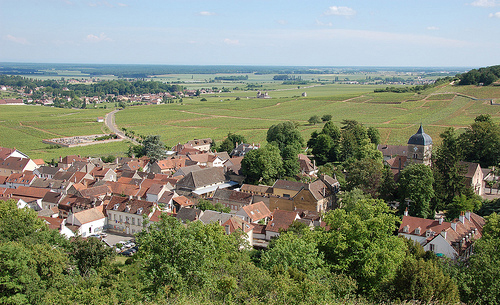
Chambolle-Musigny is a wine appellation that includes some of the finest French Burgundy wine. Wine so labeled must come from vines planted in the commune of Chambolle-Musigny, which is situated in the Côte de Nuits region of the Côte-d’Or department in Burgundy in eastern France.
Chambolle-Musigny is a generally square-shaped commune lying between Vougeot to the north and Morey-Saint-Denis to the south. The Grône River, flowing southeasterly, bisects the commune as it runs from the heights above the village through a natural valley (“combe”) toward the Route National 74. Two slopes rise from the river valley at either end of the commune. The name “Chambolle” derives from the Latin campus ebulliens, or boiling field (champ bouillant), which was apparently descriptive of the Grône when swollen and overflowing its banks into the adjoining fields after a rainstorm.
The commune does nor appear to have been settled in antiquity and first emerges in the historical records around 1110 A.D. as “Cambolla,” a vineyard area run by the ubiquitous monks of Cîteaux. From the early 14th century until the early 16th century, Chambolle was a vicarage of Gilly-les-Cîteaux.

The vineyards of Chambolle-Musigny occupy 180.31 hectares, of which 94.69 produce village-level Chambolle. There are 61.36 hectares of premier cru Chambolle divided among 24 different climats, although only a few of these are well known. The best known is Les Amoureuses, which is essentially a Grand Cru in all but name. The best of the rest include Les Charmes, Les Fuées and Les Cras. There are 24.24 hectares in Chambolle that contribute to the commune’s two grands crus, Le Musigny and Bonnes Mares. Virtually the entire production of the commune is red. Only one tiny and rare cuvée of white, Le Musigny blanc from de Vogüé.
Chambolle-Musigny is unique in the Côte de Nuits for the chalky composition of its soils (unlike the clay soils relevant elsewhere). The thin, calcareous layer clings to a hard rocky soil beneath, which stresses the vines and sharply restricts their yield. These soils are largely responsible for the singular qualities of Chambolle-Musigny: in the words of the Burgundian poet Gaston Roupnel, wines of supreme delicacy, special wines of silk and lace.
The leading producers of Chambolle-Musigny include Domaine Comte Georges de Vogüé, Domaine Georges Roumier, and Domaine J-F. Mugnier.
Vineyard Description: Chambolle-Musigny, LES AMOUREUSES, Premier Cru
Posted in Appellations, Burgundy, Vineyards, Wine on April 21, 2010| 2 Comments »
Les Amoureuses is a small 5.42-hectare Premier Cru climat located in the commune and appellation of Chambolle-Musigny. By nearly every criterion, including critical acclaim and price, Les Amoureuses is a Grand Cru in all but formal declaration. The vineyard, comprised of two parcels, is situated immediately to the east and downslope of Les Grands Musigny, with very similar soil and exposition. The vineyard faces east, southeast from a steep slope varying between 240 and 280 meters. The soil is a mixture of sand and gravel with a bit of red clay. The thin soil sits directly over Bathonian limestone cliffs, faults in which allow the vine roots to reach down through 10 meters of oolitic minerality.
The vineyard name may come from its putuative capacity of the wines to induce one to fall in love, although a more prosaic explanation relates to the finely perfumed aromas of the wine. It is no surprise, in either event, that the wines of Les Amoureuses are intensely seductive and beguiling with real finesse.
The largest single owner of Les Amoureuses is Robert Groffier, although his wines tend to underperform in comparison with those of Domaines Comte Georges de Vogüé, Georges Roumier and J-F. Mugnier.
 Jockovino


