Feeds:
Posts
Comments

Archive for the ‘Wine’ Category


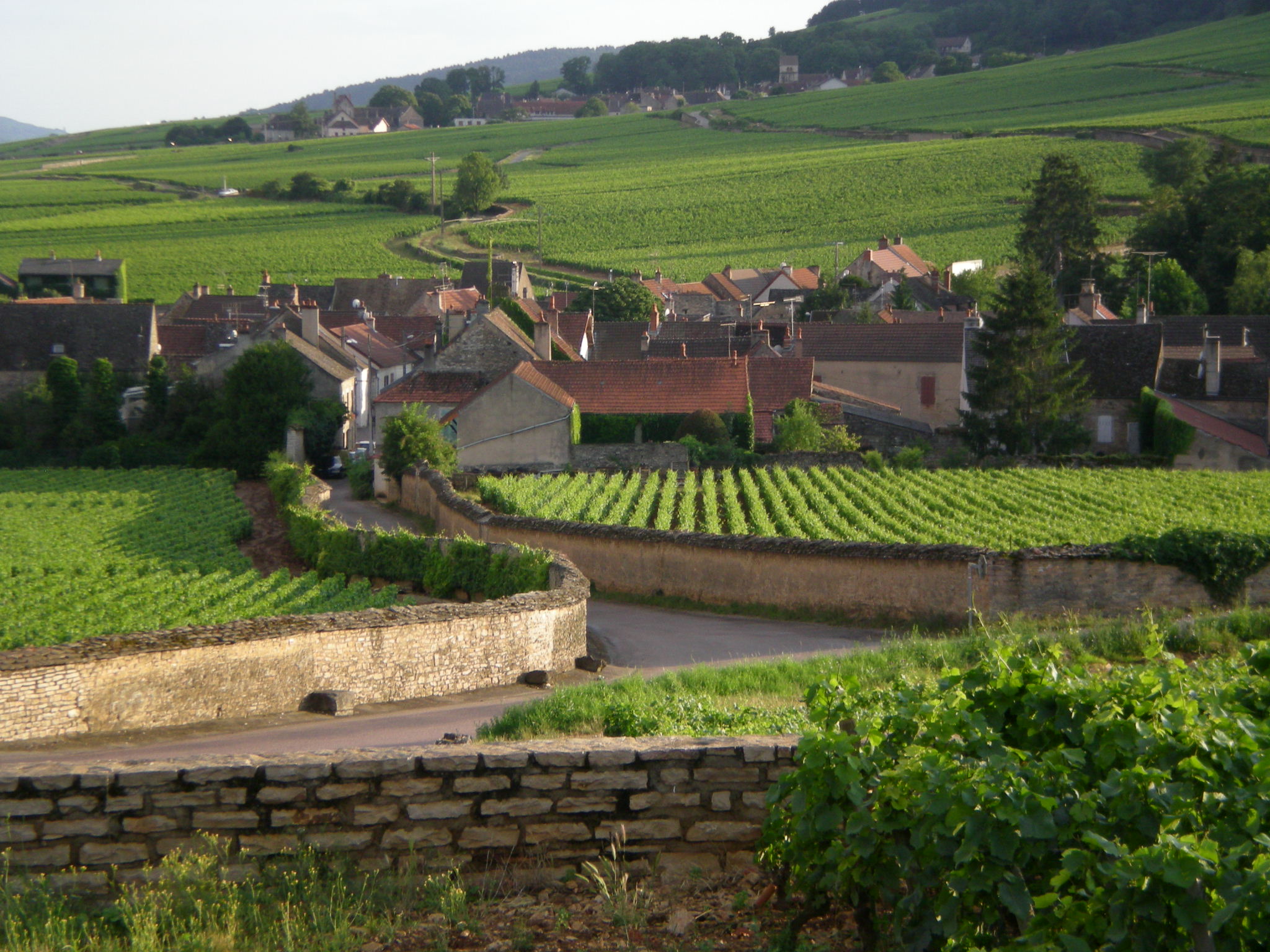
One of the most durable images of the Burgundian is the laconic peasant, face deeply etched and hands callused by years of exposure to the elements, beret akimbo, and a Gauloise à la Bogart. His education has been assimilated from generations of winemakers, and his worldview has remained congruent with the medieval Duchy of Burgundy. As compelling and charming as this iconic image may be, the reality is often strikingly different.    

The Domaine de l’Arlot, which is financed and controlled by the international financial services company AXA, stands as testimony that world class Burgundy does not invariably require the  

Domaine de l'Arlot

enduring stewardship of a single family, toiling in the vineyards and cuverie with techniques passed on from father to son. A well-advised and skillfully-led corporation can in fact bring in a professional overseer and produce superb Pinot Noir that faithfully manifests its terroir.    

The Domaine surrounds a château constructed in the 17th century from hewn Premeaux limestone. With adjoining vineyards and gardens, the château was  acquired and restored by Jean-Charles Viénot in the late 17th Century. His son François Viénot erected a surrounding stone wall, adopted the name of the l’Arlot stream, and the Clos de l’Arlot  was born. Maison Jules Belin, one of Burgundy’s most prominent 19th century négotiants, acquired the property in 1891, at which time it also bought the Clos-des-Forêts and the Clos de Chapeau. The Maison’s fortunes declined through the twentieth century and the estate fell gradually into disrepair.    

In 1987, the able head of AXA, Claude Bebéar, learned that Clos de l’Arlot and surrounding vineyards were available, and he moved quickly to acquire them. To spearhead the operation of the properties, newly baptized as the Domaine de l’Arlot,   Bebéar selected Jean-Pierre de Smet.    

De Smet was English-born and raised in Nice. Trained as an accountant, he set off as a young man for New Caledonia where he ran a business and    

Founding Winemaker, Jean-Pierre de Smet

 indulged his love for sailing. On a whim which was to change his life, Jean-Pierre spent 1977 in Burgundy with his friend Jacques Seysses at Domaine Dujac. He thereafter trained at the University of Dijon and continued assisting Seysses at Dujac for nearly a decade until, in 1987, the call came from another friend, Claude Bebéar.    

The estate acquired from Maison Belin consisted of 13 hectares, 7.1 hectares of the monopole Premier Cru Clos des Forêts-Saint-Georges, all planted in Pinot Noir; 4 hectares of the monopole Premier Cru Clos de l’Arlot, planted half with Pinot Noir and less than half with Chardonnay (the remaining fraction is planted with Pinot Beurot); and 1.8 hectares of Côte-de-Nuits Villages, Clos du Chapeau. AXA and De Smet have since added a couple of other small parcels, 25 ares of Grand Cru Romanée-St-Vivant and 85 ares of Premier Cru Vosne-Romanée, Les Suchots.    

Jean-Pierre subsequently brought in Lise Judet as co-gerante and Oliver Leriche as his technical director to supervise the making of the wine. The new regime transformed the viticulture from prevailing commercial practices to a more organic approach. They ceased using herbicides in favor of manual ploughing, and replaced insecticides with natural treatments. At present, viticulture is completely organic with a strong biodynamic orientation.    

Yields of the Pinot Noir are kept low, with a yield of 35 hl/ha on average, through a system of severe pruning as well as by using only compost to fertilize. At harvest, the grapes are handpicked into small baskets and then rigorously sorted in the vineyards to remove any imperfect bunches. The whole bunches are then rushed to the cuverie where, after another triage and little or no de-stemming, the bunches are vatted and allowed to cool gently.  The free run juice is allowed to begin fermenting with the resultant carbon dioxide retarding oxidation of the whole grapes, which themselves macerate slowly for 2-3 days before natural fermentation begins. According to    
Olivier Leriche

Leriche, this process breaks down the grapes, and helps extract a maximum of color, complexity and aroma. Fermentation temperatures are naturally maintained below 32° C.    

The cuvaison lasts between two and three weeks. This wine is then racked and some press wine may be added if needed for structure. After a one day débourbage, the wine is moved into oak casks (40% new for the Premier Cru), where it undergoes malo and rests on its lees in a cool cellar for 15-18 months. Generally, the wine is racked only twice before it is lightly fined (with egg whites) and bottled without filtration.    

The white wine, which comes from a section of the Clos de l’Arlot, is made mostly from old vine Chardonnay but also includes some rare Pinot Beurot. White wine in the Côte de Nuits is unusual, even more so when it comes from a Premier Cru vineyard. As with the Pinot Noir, the white grapes are fermented in whole clusters. After pressing, the must is cooled and, following débourbage, is racked into a tank (to retard oxidation) until fermentation begins. It is then placed into 25% new oak where it rests for about a year. Before bottling, it is lightly fined and filtered.
Read Full Post »


           Meursault is a wine appellation that includes some of the finest white French Burgundy. Wine so labeled must come from vines planted in the commune of Meursault situated in the Côte de Beaune region of the Côte d’Or department of Burgundy in eastern France.       

           The commune of Meursault, which extends south from Volnay, and immediately north of Puligny-Montrachet,  is the largest white wine producing area of the Côte-de- Beaune. To the northwest and north-northwest of Meursault are found Auxey-Duresses and Monthélie; toward the northeast is Volnay.      

          Meursault is the social and financial center of that portion of the Côte-de- Beaune referred to as the “Côte des Blancs” on account of the preeminent quality and reputation of its white wines. Meursault, Chassagne and Puligny comprise this part of the Côte-de-Beaune that is almost universally acknowledged as producing the finest Chardonnay-based wines in the world.      

            The suggestion, not infrequently made, that the name Meursault derives from the Latin for “mouse jump” (muris saltus) is risible at best, most likely the idle conjecture or schoolboy humor of a bored Latin student from a rival village.  Though etymological conjectures are always problematic, Meursault far likelier derives from the Celtic mare + saulis, or swamp willow (modern Fr. saule de marais). The lower part of the village is quite flat although today, fortunately, is quite dry.      

          The vineyards of Meursault occupy 436.82 hectares, of which 304.94 produce village-level Meursault. Many of these village-level wines boast well-known lieux-dits, and produce wines that rival many premiers crus. Best known perhaps are Lafon’s Clos de la Barre and Desirée, but other worthies include Les Tessons, Les Narvaux, Les Casse-Têtes and Les Clous.      

          While there is no grand cru, there are 131.88 hectares  of Premier Cru Meursault divided among different climats, the best known of which are Les Perrières (13.72 hectares ), Les Genevrières (16.48 hectares ), Les Charmes (31.12 hectares ), Les Poruzots (11.43 hectares ) and Les Gouttes d’Or (5.33 hectares ).      

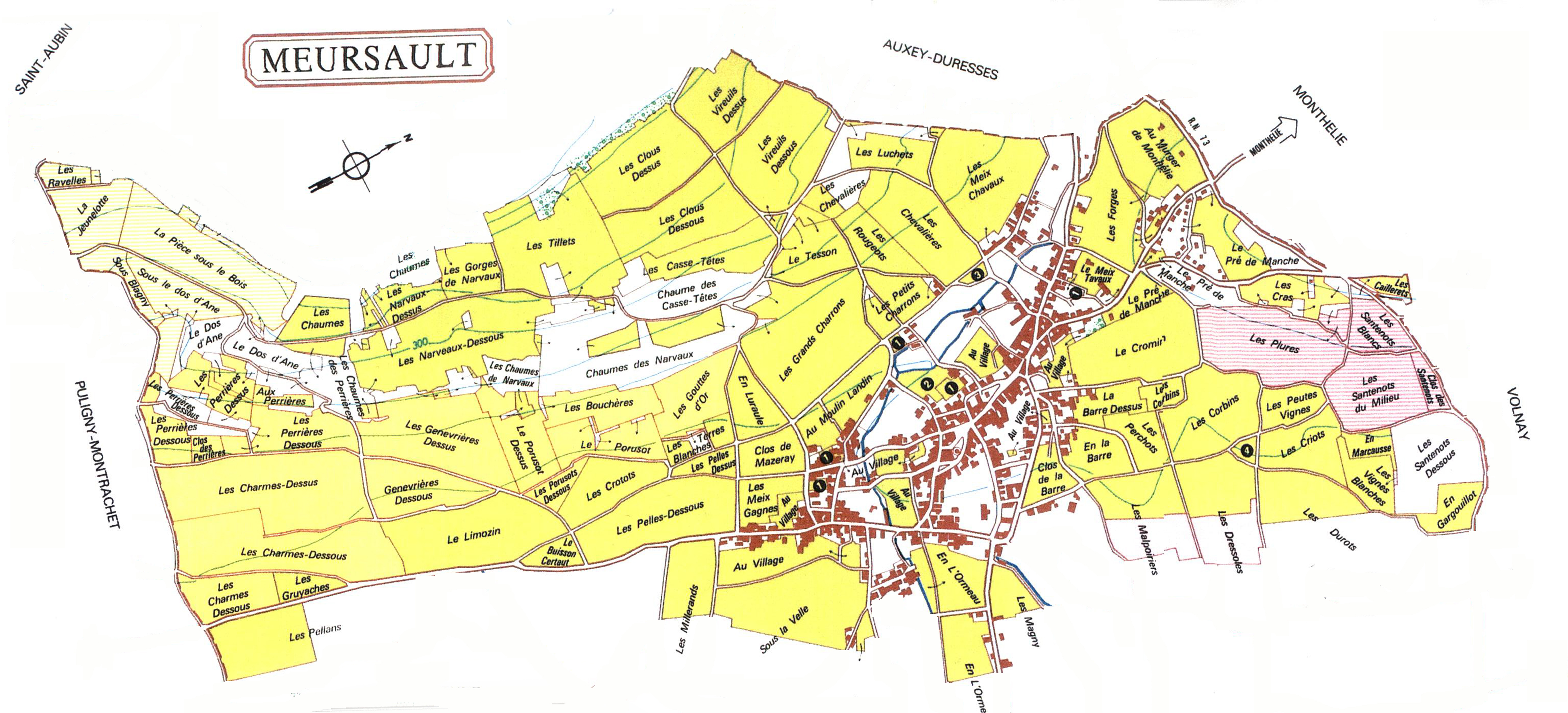
          The commune of Meursault is roughly fish-shaped, with the head pointing northeast toward Volnay and the tail abutting Puligny-Montrachet. The town of Meursault bifurcates the fish just behind the head. The “fishhead” section, northeast of the village, is geologically and viticulturally a continuation of Volnay and Monthelie. The soil is comprised of a mixture of clay, pebbles and iron-rich scree over a base of Bathonian limestone. Most of the best wine produced from this sector is red. Since Meursault has long been renowned for its white wines, and since neighboring Volnay once produced the most  sought-after of reds, the vignerons of the fishhead sector won the right to sell their red wine as Volnay even though their vines are situate in Meursault. The best known vineyard here is Santenots.      

Meursault: fish-shaped      

          South of the village the geology changes markedly. Here the vineyards are spread out over gentle slopes whose easterly exposure, along with an abundance of Bathonian and Callovian limestone and white marl create an ideal environment for Chardonnay. Up slope toward Auxey-Duresses, the soil becomes increasingly thin, covered with scree and underlain with friable schiste. The finest terroirs in this sector, and the location of the Premiers Crus, are found in a band running parallel to the RN 74, in the middle third of the “fish”, extending from the tail to approximately the center.      

"I would not wish my Creator to see me grimace at the moment of Communion."

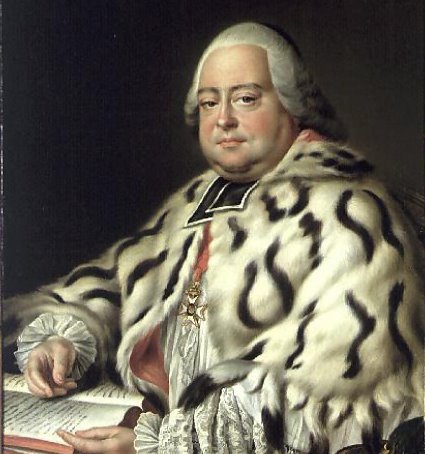
           Simultaneously opulent, subtle and delicate, Meursault matures slowly over a long period of time. Cardinal de Bernis, Louis XIV’s ambassador at the Holy See, always took care to celebrate mass with a Meursault, lest his Creator witness him wince during Holy Communion.  “I would not wish my Creator to see me grimace at the moment of Communion.”            The best-regarded sources of Meursault include Patrick Javillier, Dominique Lafon, François Mikulski, and Jean-Marc Roulot.

Read Full Post »


Pommard is a wine appellation that produces excellent red Burgundy. Wine so labeled must come from Pinot Noir vines planted in the commune of Pommard situated in the Côte-de-Beaune region of the Cote d’Or department of Burgundy in eastern France.    

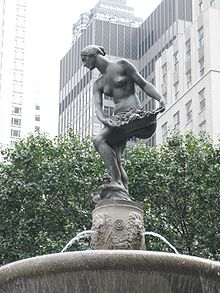
South of Beaune are found the two communes, Pommard and Volnay, whose wines (apart from the Grands Crus of Corton) comprise the finest red wines of the Côte-de-Beaune.  The name Pommard, by tradition, derives from Pomona, the Roman goddess of fruit trees and orchards, to whom early Gauls dedicated a temple on the site. This is the same goddess Pomona who    

The goddess Pomona

appears in full golden mufti on the Great Seal of the City of Los Angeles and whose bare pulchritude is captured by a demure statue now situate in the fountain in front of the Plaza Hotel in New York City.    

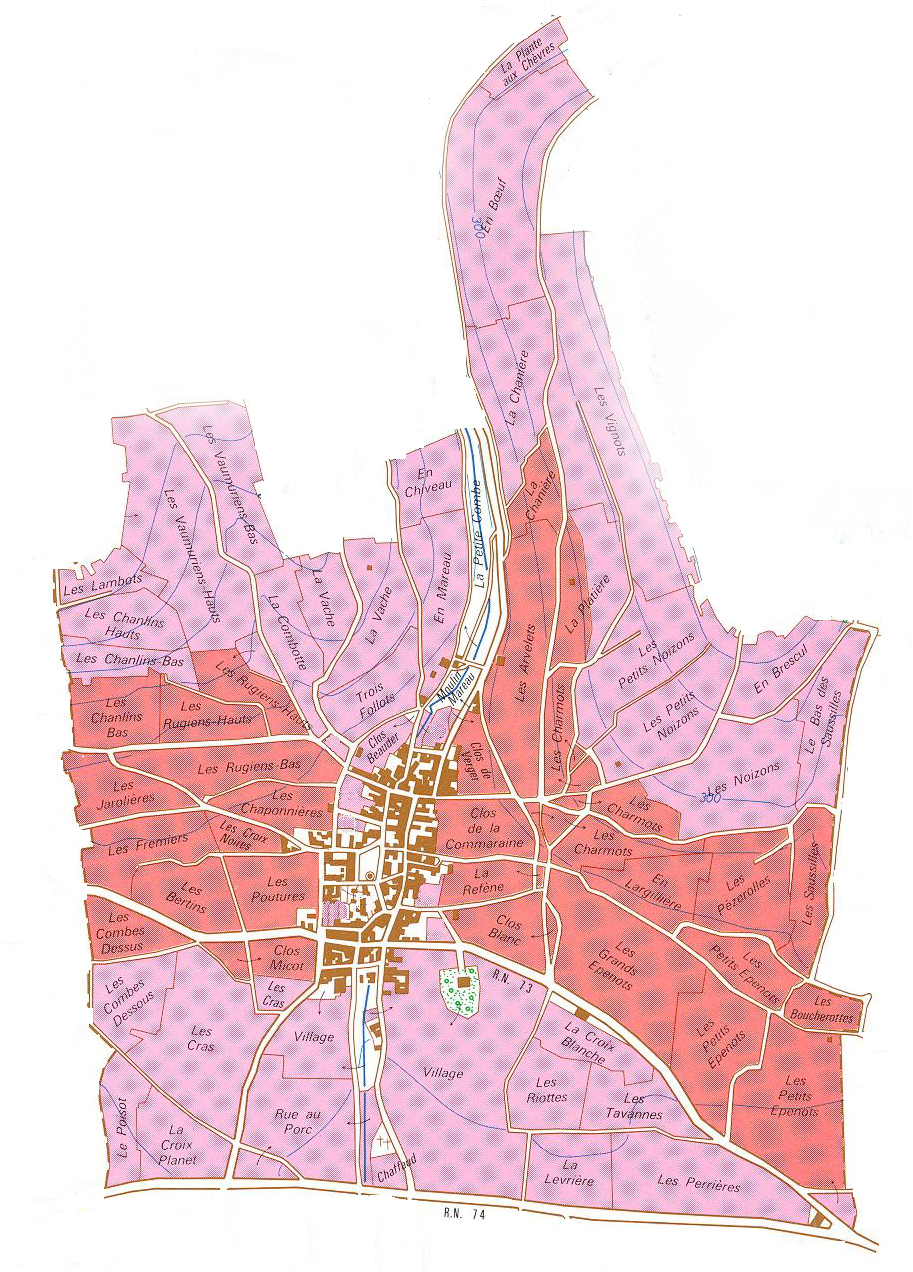
The commune of Pommard lies immediately adjacent to Beaune, and begins at the point where the Route forks into the Autun Road (RN 73) and the RN 74. Pommard is generally square-shaped with a center band, running more or less north-south, containing the 24 Premier Cru parcels totalling 125.19 hectares,  and 211.63 hectares of village-level Pommard. Total production averages around 13,532 hectoliters of wine per year, entirely red. There are presently no Grands Crus although Rugiens-Bas is expected to be promoted and Clos des Epeneaux would also be deserving.    

The prime vineyards in Pommard are generally thought to be located either on the Beaune side, where are found Les Pézerolles and Les Epenots; or to the south of the village, notably Rugiens-Bas. Interestingly, these two sections produce wines of distinct contrast. The stonier, better-drained soils of Les Pézerolles and Les Epenots produced finer, more delicate wines, whereas the iron-rich, clay soil of Rugiens-Bas produces more powerful and richer wines.    

Pommard

The vineyards of Pommard generally face south and southeast. The soil is somewhat varied in the commune, although there prevails generally a subsoil base Argovian limestone with an admixture of ferrous clay and marl. The thinner and rockier soils are found, not surprisingly, on the slopes above the city toward Beaune; and these give way to increasingly ferrous clay soils as the slope continues downward toward Volnay. Only in the area above the Epenots wall, along the Autun Road, is there much calcareous debris and pebbles.    

Among the finest producers of Pommard are Domaine de Montille and Comte Armand (Clos des Epeneaux).

Read Full Post »


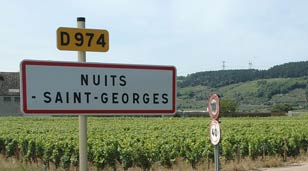
   Nuits-St-Georges is a wine appellation that includes some of the finest and best-known French Burgundy wine. Wine so labeled must come from vines planted in the commune of Nuits-St-Georges (or the adjoining commune of Prémeaux-Prissey with which it is viticulturally joined) situated in the Cote de Nuits region of the Cote d’Or department of Burgundy in eastern France.

                      In From the Earth to the Moon, author Jules Verne envisioned in 1867 that the first lunar explorers would celebrate their moon landing with “a fine bottle of Nuits.”    In 1971, to commemorate Verne’s sci-fi forecast, Apollo 15 astronauts named one of the moon’s craters “St. George Crater”. Completing the circle, the town council in Nuits-St-Georges rechristened the main square in the village Place de la Cratère. The vineyard of St-Georges, celebrated by Verne and Apollo 15, has been successfully producing wine of the first rank for at least one thousand years.

                      Leaving Beaune and heading north toward Dijon, Nuits-Saint-Georges (together with its viticultural Siamese twin Prémeaux-Prissey) marks the gateway of the Côte-de-Nuits, the Oz of Pinot Noir. The commune has been inhabited since antiquity and the vestiges of  a substantial Gallo-Roman villa have recently been excavated. The name “Nuits” is derived from the Latin “nutium,” signaling the fine walnuts that were once prolific in the area.  

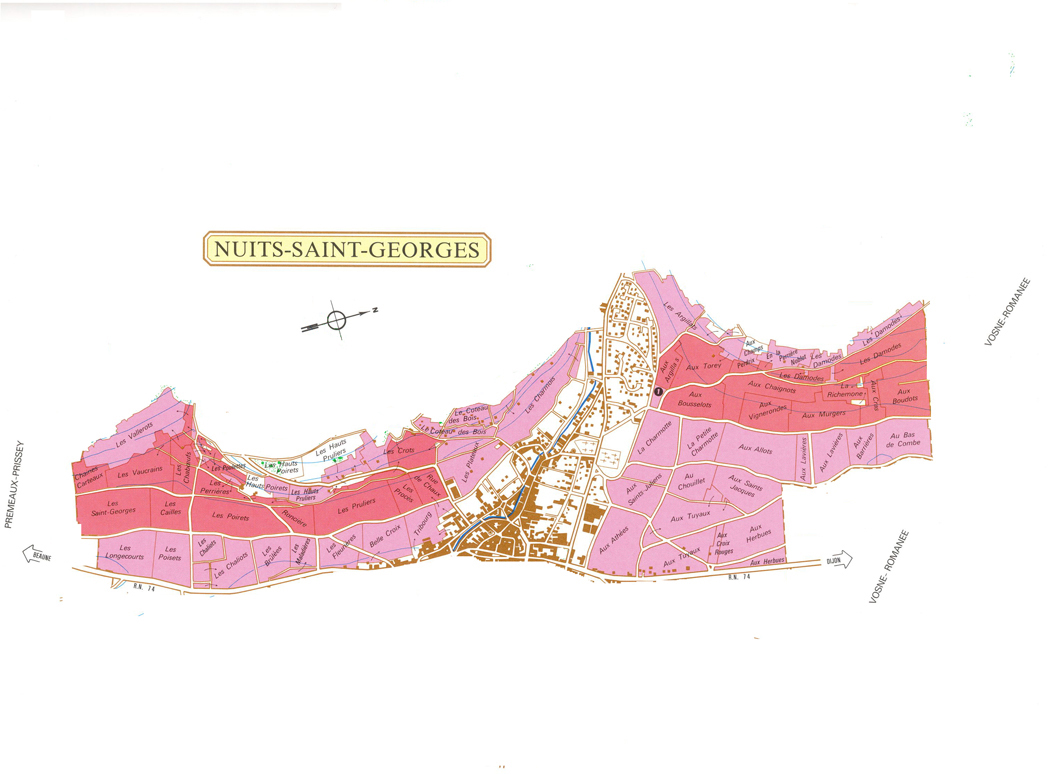
                      Nuits St Georges, together with Prémeaux-Prissey, comprises 322.59 hectares, including 37 premiers crus aggregating about 147 hectares and about 175 hectares of village-level vineyards. The soil types fall into three sections. The town and the vineyards are bisected by the Meuzin River, which flows east from the hills above the town. North of the river, toward Vosne-Romanée, lies the first section. There, the soil is a continuation of Vosne: an admixture of limestone with a small amount of clay over a Bathonian limestone base, and covered with pebbles and scree. Most prominent among these vineyards are Aux Boudots, Aux Thorey and Les Damodes. To the south of the Meuzin River, toward Beaune,  lies the second section. Here the soil is somewhat richer and deeper, certainly with a higher clay content, but also with sand and gravel. The base here is comprised mostly of hard Comblanchien limestone. Most prominent here is the commune’s signature vineyard, Les Saint-Georges.  Further south, and within Prémeaux-Prissey, is found the third section. In the higher elevation, toward 320m,. Here the soil is quite thin and fine, particularly in the Clos de l’Arlot. Further downslope can be found Clos de Forêts, Les St-Georges and Clos de la Marechale.

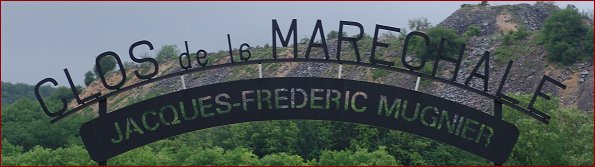
                    Among the best-regarded sources of Nuits-St-Georges are Joseph Faiveley, Henri Gouges, and Domaine de l’Arlot. Other well-known producers with notable vineyards in Nuits-St-Georges include J-F. Mugnier (Clos de la Marechale).

Read Full Post »


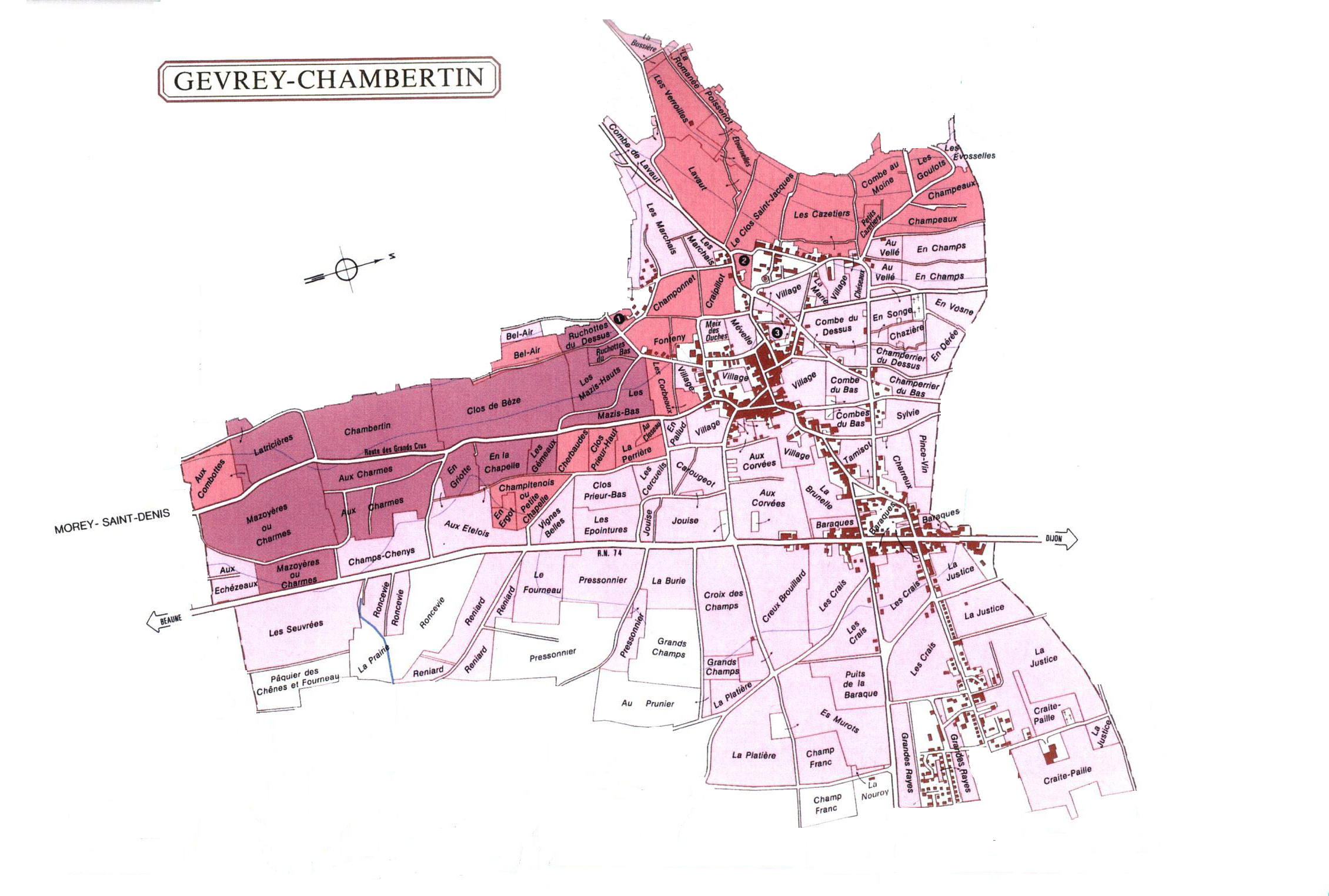
Gevrey-Chambertin is a wine appellation that includes some of the finest and best-known French Burgundy wine. Wine so labeled must come from vines planted in the commune of Gevrey-Chambertin (or the adjoining commune of Brochon with which it is viticulturally joined) situated in the Côte de Nuits region of the Côte-d’Or department in Burgundy in eastern France

Gevrey-Chambertin produces some of the world’s most famous Pinot Noir-based wines. The best examples of Gevrey-Chambertin are rich, deeply-colored and sumptuous. Above all, according to Jancis Robinson, they are “complete” wines. Laying claim to the sobriquet, “King of Wines. Wine of Kings,” Gevrey-Chambertin, according to the poet Gaston Roupnel,  expresses “All that great Burgundy can be.”   Gevrey-Chambertin is the largest (532 hectares; about 2 square miles) commune in the Côte-de-Nuits. It lies just north of Morey-St-Denis along the Beaune-Dijon Highway (RN 74), 31 km from Beaune and  14 km from Dijon. The appellation comprises not only the commune of Gevrey-Chambertin but also 11 climats in neighboring Brochon.  Unusually for Burgundy, there are classified vineyards on both sides of the highway.  All wine from Gevrey-Chambertin is red, derived entirely from Pinot Noir.   

 In 630 A.D., the Duke of Amalgaine donated a 14 hectare vineyard to the Abbey of Bèze, which was (avant-garde) one of the only cloistered orders to house both monks and nuns. The area was recorded in Roman records as “Gabriacus”, Romano-Gallic argot for goat, possibly after an epithet hurled at some of the randier monks by the Abbotess of Bèze. Perhaps because of its libertine ways, the Abbey of Bèze and its vineyards came under the authority, first, of the Benedictines at Cluny and later the Trappists of Cîteaux.   

  As to the name Chambertin, by which name the best wines have long been called, a highly dubious but oft-repeated local legend teaches that a peasant named Bertin planted some vines nearby in a champ (field), conjoining his name and christening the vineyard Champ de Bertin, or Chambertin.  Since the entire wine-producing area was under the firm control of rich and powerful monasteries, who profited handsomely from sales of wine, and since peasants by definition didn’t own land anyway, the most one can do is to smile tolerantly. In 1847, King Louis Philippe, by royal decree, changed the town name from Gevrey to Gevrey-Chambertin.  

Napoleon was particularly partial to the wines of Chambertin and, according to another problematic tradition, drank little else from the signature bottles emblazoned with an “N”. Napoleon even laid in a good stock for his ill-fated journey to Moscow, and then suffered the double indignity of losing the war and having his bottles “liberated” by marauding Cossacks.  

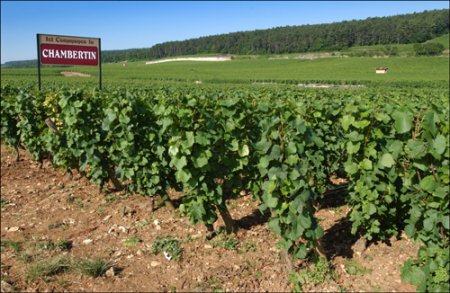
               Gevrey-Chambertin includes 9 grands crus totaling 87.06 hectares: Chambertin, Chambertin Clos de Bèze, Chapelle-Chambertin, Charmes-Chambertin, Mazoyères-Chambertin, Latricières-Chambertin, Mazis-Chambertin, Griotte-Chambertin and Ruchottes-Chambertin. These vineyards are situated south of the village on a slope with eastern exposure and an altitude of 260-320 meters. The soil is a mixture of clay and gravel, and white marl over a base of limestone.  


               There are 26 premiers crus occupying 85.53 hectares, most notably Le Clos St-Jacques, Lavaux St-Jacques, La Combe aux Moines. Half of the premiers crus are sited around the perimeter of the grands crus.  The other half, generally thought to be better on account of their calcareous clay soils, are found on a steep, southeast-facing slope to the north. The remaining 359.89 hectares, of which 50.59 lie in the adjoining commune of Brochon, produce the village wines of Gevrey-Chambertin. The flatter lands, which abut the highway, show higher concentrations of clay.  

               The finest producers of Gevrey-Chambertin include Armand Rousseau, Denis Bachelet, and the Domaine de la Vougeraie.

Read Full Post »


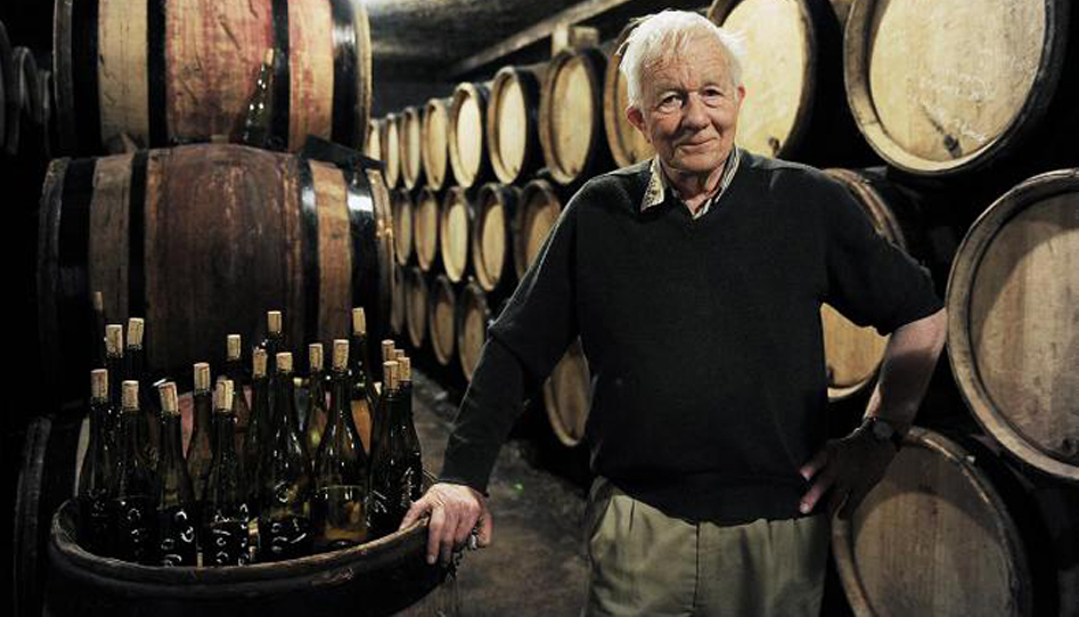
Michel Lafarge

The original Burgundians were most likely a Scandinavian people whose roots can be traced to the southern shores of the Baltic. The present island of Bornholm off peninsular Denmark, known in the Middle Ages as Burgundarholm, bears linguistic testimony to this origin. During the first century A.D. the Burgundians migrated west to the northern border of the Roman Empire. The Burgundii, as they were known by the Romans, crossed the frozen Rhine on New Year’s Eve 406 A.D.,  and established a kingdom on the Rhine’s west bank. Before the end of the century, however, the Regnum Burgundiae was attacked and destroyed by the Huns. The destruction of this kingdom is recounted in one of the great literary triumphs of the Middle Ages, the Nibelungenlied, which provided the basis for Wagner’s Ring. 


The cellars at Domaine Michel Lafarge were built at around the same time as the Nibelungenlied was being written:  13th century AD. People were clearly much shorter when the cellars were built and it is not too difficult to imagine the Nibelung Alberich scurrying about in search of a prized bottle of ancient Clos-des-Chênes.

There is a very strong sense of history that permeates Domaine Michel Lafarge in Volnay. This is reinforced by the father-and-son team, Michel and Frédéric, who jointly manage the estate and make the wine using very traditional methods and with knowledge handed down over the generations. Just so, they remain open to innovations that prove their value through experience. Michel’s commanding stature and piercing blue eyes confirm his kinship to the Viking raiders who crossed the frozen Rhine, just as his gracious manner and charm manifest the qualities that have enabled the Burgundians to prevail over other competing tribes of the region over the centuries.

As fits their respect for the tried and true, the Lafarges have resisted the rush to embrace clones and continue to use a sélection massale. Their objective is to use old vines and small yields, and they contend that clones have a tendency to be overly productive. Similarly, the Domaine prefers the Cordon system of pruning over the more prevalent Guyot , believing that Cordon produces a smaller overall yield: more individual berries but of demonstrably smaller size and thus smaller overall quantity of more concentrated juice. As a secondary benefit, Michel and Frederic are convinced that Cordon makes the vines more resistant to disease by spacing out the vegetation and facilitating treatments against rot and other diseases. If such treatments do become necessary, traditional methods of control such as copper and sulphur are employed. Even then, the Lafarges will prepare their own Bordeaux mixes rather that rely on the ready made products of agrochemical companies. Modern chemical treatments and herbicides are eschewed and only modest amounts of organic compost are ever used to fertilize when necessary.

With their primary objective of old vines and low yields, they will on a selective basis green harvest young vines and other prolific vines, such as those clones that the Lafarges have allowed on an experimental basis. They also scrupulously  excise verjus (unripe, green grapes), both on the vines and in triage at the cuverie. Just as does their neighbor and friend Etienne de Montille at the Domaine de Montille, the Lafarges  reject blanket rules of vinification and tailor techniques in accordance with the peculiarities of the vintage. “There are no rules,” says Etienne, although the statement could have been pronounced with equal conviction down the street at Domaine Lafarge.

Typically, though not invariably, the Lafarges will destem between 80% and 100% of the bunches, with total destalking favored in less ripe vintages when the presence of unripe stalks will be more likely to add a herbaceous

Frédéric and Michel Lafarge

quality to the must, although the presence of some stalks will tend to lengthen the period of fermentation and decrease the temperature of the fermenting must. There is a decided preference for a longer and cooler fermentation period. They reject the use of enzymes and commercial yeasts, adhering to a natural pre-fermentation maceration with a transition into fermentation prompted by the action of natural, indigenous yeasts.

Cuvaison will typically occupy 10-14 days, with temperatures kept at between 28° and 32°C. Heat exchangers are anathema, however, and the fementation temperature is regulated by controlling the ambient temperature in the cuverie. In less ripe years, the fermention is hotter and shorter: hotter in order to extract more fruit and tannin, and shorter to resist the less attractive qualities of the unripe secondary flavors. A cooler and longer fermentation period is perceived as better able to gently extract the elegant secondary flavors.

Although generally opposed to saignée, the Lafarges will employ the practice in years when they conclude that dilution might otherwise occur. They strenuously resist any pumping in the cuverie and will move the pulp to the press by hand to avoid damaging the fragile fruit. For the same reason, the press is manually controlled to allow the gentlest possible extraction of press wine from the pulp. In any event, very little vin de presse is ever used, with between 5-10 % the norm.

New wood is sparingly used, with typically only about 25%, although up to a third may be used in ripe years for Premier Cru. Racking is delayed as long as possible, by up to one month if the lies are healthy and the ambient temperatures are low enough. A second racking will occur once malo is complete. Total élevage will generally last between fifteen and twenty months. The wines are rarely filtered and finished with only a light fining with egg whites before bottling.

Domaine Lafarge is comprised of approximately 12 hectares of vineyards. There are 1.28 ha of Chardonnay in Meursault, and 1.1 ha of Aligoté. Except for small portions of vineyards devoted to Gamay for inclusion in their stellar Passetoutgrains, the remainder of the Lafarge vineyards are planted in old-vine Pinot Noir. Their best known vineyards are in Volnay Premiers Crus, and include .97 hectares of Clos des Chênes, .57 hectares of Clos du Château des Ducs, and .30 hectares of Les Caillerets, and small plots of Chanlins and Les Mitans. The Domaine also produces noteworthy Beaune, includes .38 hectares of Premier Cru Les Grêves, and .20 ha of Les Teurons; and a tiny quantity of Pommard from a .14 hectare vineyard in Pommard Premier Cru Les Pezerolles.

Read Full Post »


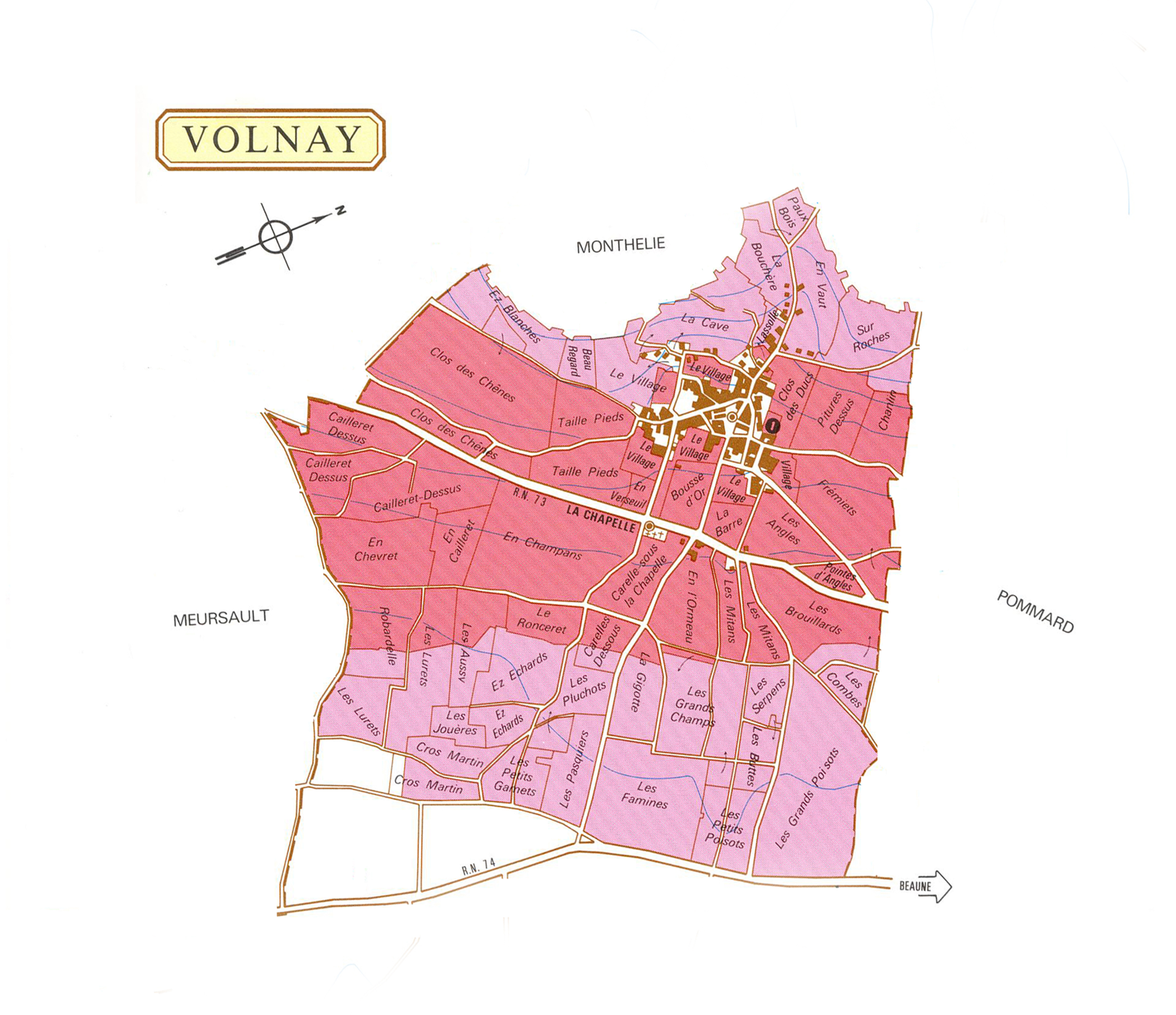
               Volnay is a wine appellation that produces some of the finest red Burgundy .  Wine so labeled must come from vines planted in the commune of Volnay (or a portion of the adjoining commune of Meursault) situated in the Côte de Beaune region of the Côte d’Or department of Burgundy in eastern France.

           Volnay is perhaps the most architecturally aesthetic village in Burgundy. Bordered by Pommard on the northeast, and Meursault to the south, the commune of Volnay lies near the midpoint of the Côte de Beaune. The name Volnay, according to Clive Coates, derives from a Celtic or early Gallic water deity, Volen. The village itself is built around a Romanesque church in the location selected by Hugues IV, Duke of Burgundy. Remnants of the hunting lodge used by the Dukes can be found a short distance from the village. The caves of Domaine Lafarge, which date from the 13th Century, are believed to have been appropriated by the Dukes and incorporated into the Château de Volnay, which was destroyed by fire in 1749.

            Volnay vineyards cover more than 213 ha. on southeasterly-exposed slopes, of which about 115 ha. are occupied by 26 premiers crus, and about 98 ha. are in village level vineyards. In addition, there are six premier cru parcels, totalling 21 ha.,  located at the northern extremity of Meursault, but entitled to Volnay appellation. Only red wines are permitted and there are no grands crus.

            Volnay is unique in that its best vineyards lie below the town (toward RN 74) and not above it, as all other communes of the Cote d’Or. The premier cru vineyards lie at mid-slope, below the town, while the lesser village vineyards are either on higher, more exposed hills above the town, or on lower and flatter terrain nearer RN 74.

            Some of the best vineyard sites are generally thought to be those immediately adjacent to the town of Volnay: Clos des Ducs, Bousse d’Or, Le Village (which includes several monopoles including Bousse d’Or and Clos du Chateau des Ducs)  Carelle-sous-la-Chapelle and Taillepieds. This soil is hard marl with a high percentage of limestone. Another prime cluster of premier cru vineyards is found south of the village toward Meursault: Champans and Caillerets among them. Here the slopes are steeper, with more eroded soils exposing Bathonian limestone, and creating stonier soils. Another distinct section lies northeast of the village toward Pommard. Here the stony soils are predominantly friable schiste. Immediately above the Autun Road (RN 73) is another soil type, the pure limestone of Clos des Chênes. The final major section is the grouping of premier cru vineyards within Meursault, notably the Premier Cru Santenots-du-Milieu. Here the soils exhibit more limestone, but offer a variety of topography and soil type.

            Volnay has long been celebrated for its elegance and grace. Characterized by seductively fragrant bouquets, the wines display intense but delicate pinot noir flavors. Volnay is often and justifiably described as  “feminine” on account of its charm and refinement.

            The “Big Three” domaines producing fine Volnay are generally conceded to be Michel LafargeDomaine de Montille and Marquis d’Angerville.

Read Full Post »

Domaine Jean-Noel Gagnard: No Doubt that Caroline Now Runs the Show

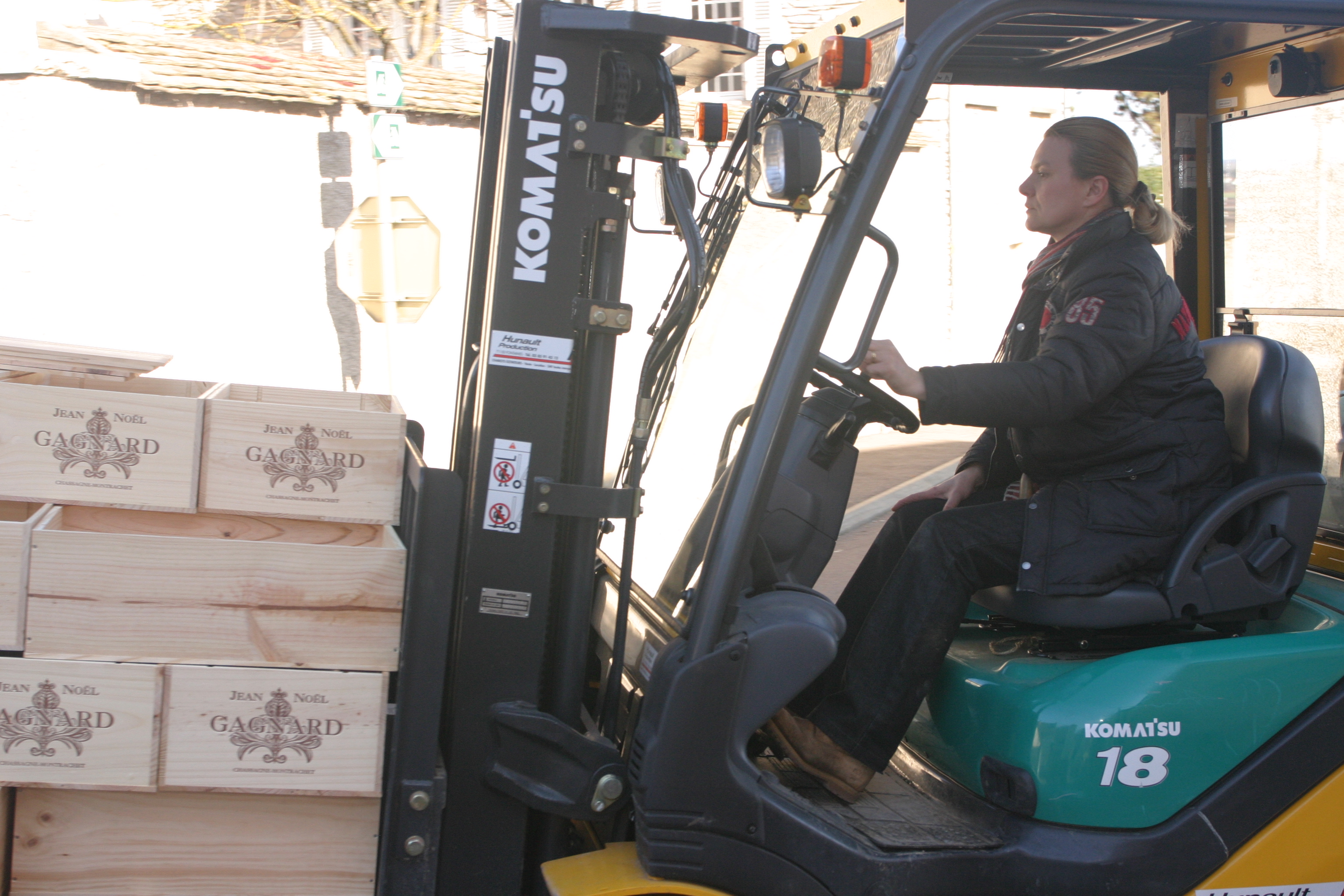
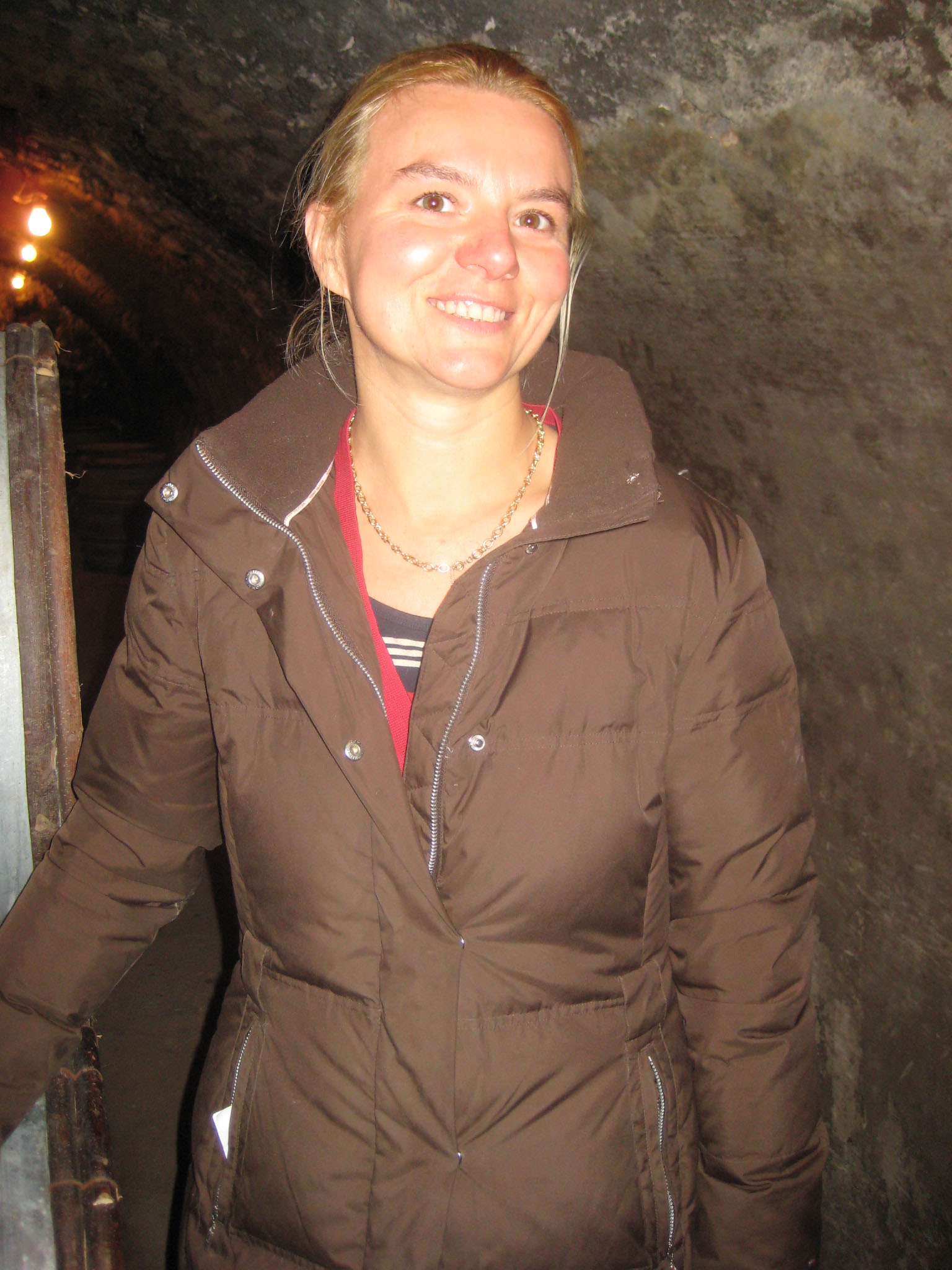
 The wines produced at Domaine Jean-Noël Gagnard reflect a mastery of terroir appropriate to a family whose roots in Chassagne-Montrachet reach back to 1632, the era of the Thirty Years’ War, Louis XIII and Cardinal Richelieu. The current winemaker, Caroline Lestimé, follows in the footsteps of her father, Jean-Noël Gagnard, making some of the richest and most intense wine in the Côte-de-Beaune, including what many consider the benchmark Chassagne-Montrachet.                

  Caroline Lestimé is an adherent of lutte raisonnée, a system of vine cultivation that is essentially organic and noninterventionist.  Lutte raisonnée entails holistic and balanced viticultural management with primary focus on microbial health of the soil and the biodiversity of the vineyard. The governing policy is to support and maintain the

Winemaker Caroline Estimée

natural ecosystem of the vineyard so that the vines can prosper without intervention, thereby naturally resisting pests and disease. The system pursues a reasoned and not absolutist approach, however, and practitioners of lutte raisonnée  will occasionally permit limited chemical intervention if certain danger thresholds are passed, and when chemicals are viewed as less harmful to the soil than alternative biodynamic treatments.   As a practical matter, lutte raisonnée  can be distinguished  from biodynamie in that the former implies the application of treatments only as a necessary response and the use of chemicals as a less harmful alternative; whereas biodynamie implements treatments systematically as prevention and employs biodynamic remedies like sulphur and copper that many vignerons believe are more harmful to the vineyard than chemical alternatives.   Lutte raisonnée , in the judgment of its practitioners, thus results in less intervention and a flexible approach that elevates the long term health of the vineyard above organic and biodynamic orthodoxy.       


          This regimen of organic farming and minimal intervention is rigorously followed at Domaine Jean-Noël  Gagnard. The plants are carefully pruned manually using Guyot simple (one cane and one spur). The vineyards are worked by hand without any chemical herbicides. If            

single Guyot pruning

necessary, natural compost can be worked into the soil to replenish the organic vitality of the vineyard.             

          The Chardonnay grapes are harvested manually and rushed to the cuverie where they are scrupulously sorted to remove leaves, unripe and damaged grapes. They are very lightly crushed with a pneumatic press, after which the must is allowed to settle for one or two days. Using only indigenous yeasts, the must is then fermented in an oak vat in the cool (18°C ) Gagnard chai, where it also undergoes  malolactic fermentation. When malo is finished, the wine is racked into barriques (228 liters),  made from Tronçais and Allier oak, the percentage of new oak varying between 33% for the Premiers Crus and 80% for the Bâtard-Montrachet. The barriques are then placed in the cold (10°-12°C.) cellars where the wine rests on its fine lies for 18 months. The wine is fined with casein, racked into assemblage, lightly plate-filtered and bottled.                  

          The Pinot Noir is similarly harvested and sorted at the cuverie. The bunches are completely de-stemmed and the berries are vatted  and allowed to macerate for ten days, during which time there is daily punching down (pigeage) and pumping over (remontage). Temperature-controlled tanks regulate carefully the fermentation process. After alcoholic and malolactic fermentation are complete, the wine is racked into oak barriques, 25% of which are new, in which it remains for 12-18 months, depending on the vintage. Prior to blending, the wine is racked and filtered with egg whites. The wine is plate-filtered and bottled.

Read Full Post »

Bonnes Mares is a 15-hectare Grand Cru climat that straddles the border of Chambolle-Musigny (where 13.5 ha are located ) and Morey-St-Denis (the remaining 1.5 ha). The vineyard is situated north of the village of Chambolle-Musigny, and borders the Route des Grands Crus in the east and Clos de Tart in the north. The east-facing vineyard lies on a very gentle slope that varies only between 265 and 300 meters in elevation. Bonnes Mares is bifurcated geologically, with the northern half (the Morey side) – called terres rouges — comprised of heavier soil with a larger component of clay; and the southern half – called terres blanches — comprised of lighter soil, with a greater concentration of rocks and limestone, and containing an abundance of fossilized seashells. The wines coming from the two sections differ considerably, with terres rouges producing more robust and sturdy wines, while the terres blanches wines more delicate  and elegant.  In either case, as Clive Coates has written, the wines are hardly Chambolle-Musigny. Instead Bonnes-Mares is sui generis: wine that is fully-textured, deep, tannic and rich.

The name Bonnes-Mares likely derives from a cloistered order of Cistercian nuns (the good mothers) that lived nearby. A more charming etymology suggests that the name derives from a now-lost bas relief unearthed that portrayed a trinity of Roman goddesses of the harvest whose images protected the vineyard.

Distinguished proprietors of the vineyard include Comte Georges de Vogüé, J-F. Mugnier, Vougeraie, and Georges Roumier.

Read Full Post »


One of the strengths of Burgundy is the variety of paths that have led so many to their apotheoses as winemakers. The conventional assumption is that Burgundian winemakers descend from soldier/farmers who fought alongside Vercingetorix against the Romans, men who were born with argilo-calcaire under their fingernails, and Pinot Noir in their DNA.  This stereotypical winemaker learned in the fields and cuverie alongside his father and grandfather, and absorbed the accumulated wisdom of generations of vignerons by the age of 10, when he produced his first vintage.

Frédéric (“Fréd”) Mugnier easily makes every critic’s shortlist of the most respected and influential winemakers in Burgundy and yet his background diverges widely from the stereotype. He was born in 1955 in Geneva, to which his parents had briefly relocated from French Indochina shortly after the fall of Dien Bien Phu. His father, trained as a lawyer, pursued a career as a merchant banker in Paris, his mother’s birthplace, where young Fréd grew up when he was not in Alsace. He took a degree in Petroleum Engineering and specialized in off-shore oil projects from the North Sea to Africa.

Fréd’s paternal forbearer and namesake Frédéric had been a successful distiller in Dijon in the middle of the 19th century, profiting greatly from the boom in Absinthe. One of the iconic absinthe posters of that era, the  Zouave by Lucien Lefevre, promoted Mugnier Absinthe. The business prospered and Frédéric acquired the Château de Chambolle-Musigny in 1863 from the Marey-Mange family, along with a few hectares of vineyards. The family added the Clos de la Marechale in 1902. The Domaine was managed for a period by Maison Faiveley and later by Bernard Clair, the cask wine being sold off in barrel to negoces. Although Fréd’s father occasionally visited the Château, especially after his retraite in 1977, he remained very removed from the winemaking and the vineyards.

Although Fréd’s father had died in 1980, it was not until 1984, at the age of almost thirty, that Fréd Mugnier heeded the Sirens of the vineyards whilst on a sabbatical. Enrolling at the Lycée Viticole, Fréd was soon a confirmed addict, completely enchanted by a passion for Pinot Noir. In the twenty-five years since taking the helm as a relative novice, Frédy Mugnier has emerged as one of the dominant influences in Burgundy, producing some of the most elegant and compelling examples of Pinot Noir.

 Domaine J-F. Mugnier, from its base at the Château de Chambolle-Musigny,  produces two Grands Crus, Bonnes Mares (.36 ha) and Musigny (1.13 ha); two Premiers Crus, Chambolle-Musigny, Les Amoureuses (.53 ha), Chambolle-Musigny, Les Fuées (.73 ha) and a village Chambolle-Musigny (1.3 ha) that is comprised of three climats, two of which are actually  Premiers Crus. Beginning with the 2004 vintage, the famed Monopole Premier Cru Nuits-St-Georges, Clos de la Maréchale (9.55 ha), reverted to Mugnier control (long under contract to Maison Faiveley). As result, the Domaine now consists of 13.79 ha of some of the best vineyards in the Côte d’Or.

Mugnier is a confirmed noninterventionist, preferring to allow the vintage and the vines to express themselves. He avoids the use of herbicides and insecticides, preferring the risk of infestation to the untoward consequences of toxic chemicals. A key to his wines, Mugnier believes, is low yields. Overall, he rarely exceeds 32 hl/ha in his vineyards.  He eschews fertilizers, regarding their absence as a simple and natural way to control yields. The best way, he contends, to keep production low is the selection of clones and rootstocks that are not naturally prolific. He does not conform, however, to the widespread practice of close-pruning as an adjunct to controlling yields. Fréd believes that short-pruning over-stimulates the vines to produce too much unnecessary foliage. He also opposes vendange vert (green harvest), the shedding of bunches in June, claiming that this practice only covers up earlier mistakes. Instead, he practices envasivage, removal of double buds, in May.

Severe triage is Mugnier’s final weapon against elevated yields. Both in the vineyards and in the cuverie, his instruction is adamant: only perfect fruit is allowed to pass. Interestingly, Mugnier also rigorously selects the stalks that he adds to the fruit. He contends that ripeness of individual stems is essential, and even goes so far as to suggest that better and riper stems come from certain vines. Depending on the vintage, up to 40% of stalks are selected for inclusion in fermentation.

There is generally a pre-fermentation cold maceration lasting for between three and five days.  After that, fermentation starts naturally, without cultured yeasts and with only the natural yeasts on the fruit. Fermentation, which occurs in open 65 hectolitre vats, covered only with a layer of inert gas, is permitted to reach high temperature (32°-33° C.) before heat exchangers kick in to lower the temperatures. There is frequent pigéage, often up to five times daily, during a cuvaison that lasts 14-23 days.

The wine is then racked into barrels to undergo malolactic fermentation. Press wine is kept segregated and only added, if at all, at an assemblage just before bottling. Mugnier uses only 25-30% new Allier barrels with a very light brûlage (toast). To preserve freshness, Mugnier racks as little as possible. Elévage typically lasts about 18 months and is followed by light fining with egg whites but little, if any, filtration.

Read Full Post »

« Newer Posts - Older Posts »