Feeds:
Posts
Comments

Archive for the ‘Burgundy’ Category

La Colombière  is a lieu-dit located in the commune of Vosne-Romanée in Burgundy’s Cote d’Or. The vineyard lies just east of that portion of the village which abuts Grand Cru vineyard Romanée St-Vivant.  La Colombière itself lies halfway between the RN74 and the village. The soil of  La Colombière is similar to the clay and limestone of other village-level vineyards east of the town, such as the Clos du Château, but is significantly less rocky.

Major owners of La Colombière include Domaine du Comte-Liger-Belair, which exploits a .78-hectare parcel just to the east of the Domaine’s monopole, Clos du Château. The southeast-facing parcel is planted with vines averaging 60-80 years. Louis-Michel Liger-Belair uses 350-liter barrels for élevage of his La Colombière.

Read Full Post »

Clos du Château is a small 0.83-hectare lieu-dit located in the commune of Vosne-Romanée in Burgundy’s Cote d’Or. The walled vineyard is a monopole of Domaine du Comte Liger-Belair, and adjoins the Château de Vosne-Romanée, where the Liger-Belair family lives and where  the Domaine’s cuverie is located. The vines were planted in 1970 in the rocky, limestone soil of the vineyard. The vineyard produces approximately 325 cases of  wine each year.

Read Full Post »

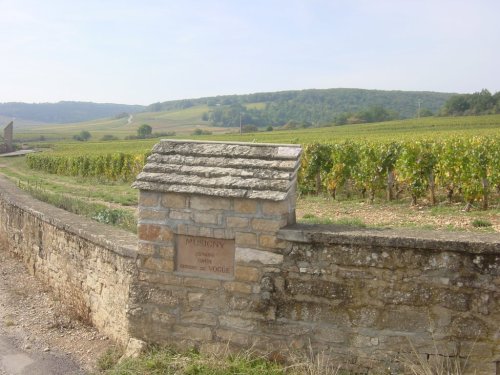
Musigny is a Grand Cru vineyard and appellation situated in the commune of Chambolle-Musigny in the Côte de Nuits sector of  Burgundy.  The vineyard lies to the south of the village itself, and borders the Grand Cru Clos de Vougeot in the southeast,  the Grand Cru Échezeaux in the south, and  the Premier Cru Les Amoureuses in the northeast.  The vineyard aggregates a modest 10.86 hectares and lies on a  slope ranging from an 8% to a 14% grade, with  elevations between 260 meters and 280 meters.  The shallow brown topsoil, which averages only 20cm-30cm in depth, is comprised of limestone pebbles and red clay over a limestone base. Similar to Les Bonnes Mares, Musigny is bifurcated by a path into a northern section, Grand Musigny, and a southern section, Les Petits Musignys, which is a monopole of the Domaine Georges de Vogüé. Grand Musigny, which faces southeast, is mostly limestone with some clay. The southern section, Les Petits Musignys,  faces south and is comprised of a higher proportion of clay. Musigny produces exclusively Pinot Noir-based red Burgundy, except for a tiny parcel of  Les Petits Musignys from which Vogüé produces a precious white wine from Chardonnay, the only one in the Côte de Nuits entitled to be labelled as Grand Cru.

It is beyond dispute that Le Musigny is one of the greatest vineyards in the world. The name derives from a Gallo-Roman settlement, Musinus, which was itself likely named after a once important but now forgotten Roman. The climat was cultivated at least by the 8th century. Certainly, by the time that the Abbey of Cîteaux founded the Clos de Vougeot in 1110, the vineyard was already producing legendary wine.

Clive Coates has written that Musigny produces red wine that “can be quite simply the most delicious to be found in Burgundy…. With … its incomparable breed, depth, originality and purity on the finish, a great Musigny is heaven in a glass.”  Perhaps more poetically, the Burgundian Gaston Roupnel wrote that “Le Musigny à l’odeur d’un jardin sous la rosée, … de la rose et de la violette à aurore.”  [“Musigny has the scent of a garden in the morning dew of the rose and violet dawn.”]

Domaine Comte Georges de Vogüé owns 7.12 hectares of Musigny, almost 65.6%, including the entirety of Les Petits Musignys. The Vogüé wines set the standard of excellence, although Domaine Jacques-Frédéric Mugnier (with 1.13 hectares) produces equally-inspired and distinctive Musigny. Equally superb examples of Musigny,  each with its own hallmark, come from tiny parcels owned by Domaine de la Vougeraie (.21 hectares), Domaine Leroy (.27 hectares), and Domaine Georges Roumier (.10 hectares).

Read Full Post »

Les Charmes is a 9.53-hectare Premier Cru climat located in the commune and appellation of Chambolle-Musigny.  Comprised of three separate parcels, the vineyard lies midslope at approximately 260 meters of elevation, to the south of Les Plantes and to the north of Les Amoureuses. The soil and style are very similar to Le Musigny and Les Amoureuses. Facing east, northeast, Les Charmes has  a limestone soil, rich in gravel and sand, with some influence of red clay, but the topsoil is thin and runs to a depth of only 40-50 cm over the underlying base of Bathonian limestone.

The vineyard name derives, alas, not from the seductive allure of its wine but from the  Latin-based word meaning field that also engendered the modern French champs (“field”).

Read Full Post »

Les Fuées is a small 4.38-hectare Premier Cru climat in the commune and appellation of Chambolle-Musigny. The vineyard is adjacent and  directly southwest (toward the village) of the Grand Cru Bonnes-Mares, and lies at about the same altitude, 280-300 meters.  As a geological continuation of the  Bonnes-Mares slope Les Fuées has very similar oolitic limestone soil. It is a cliché but nonetheless accurate to generalize that Les Fuées bears almost the same relation to Bonnes-Mares as Les Charmes does to Le Musigny: Les Fuées is a “junior” Bonnes-Mares, closely resembling its senior in terroir and falling just short of Grand Cru quality.

The vineyard name, Les Fuées, refers (in the Burgundian dialect) to the vineyard area that a farmer can daily tend with a hoe.

Exemplary Les Fuées is produced by Domaine J-F. Mugnier and by Maison Joseph Faiveley.

Read Full Post »


 Chambolle-Musigny is a wine appellation that includes some of the finest French Burgundy wine. Wine so labeled must come from vines planted in the commune of Chambolle-Musigny, which is situated in the Côte de Nuits region of the Côte-d’Or department in Burgundy in eastern France.

Chambolle-Musigny is a generally square-shaped commune lying  between Vougeot to the north and Morey-Saint-Denis to the south. The Grône River, flowing southeasterly, bisects the commune as it runs from the heights above the village through a natural valley (“combe”) toward the Route National 74. Two slopes  rise from the river valley at either end of the commune. The name “Chambolle” derives from the Latin campus ebulliens, or boiling field (champ bouillant), which was apparently descriptive of the Grône when swollen and overflowing its banks into the adjoining fields after a rainstorm.

The commune does nor appear to have been settled in antiquity and first emerges in the historical records around 1110 A.D. as “Cambolla,” a vineyard area run by the ubiquitous monks of Cîteaux. From the early 14th century until the early 16th century, Chambolle was a vicarage of Gilly-les-Cîteaux.

The vineyards of Chambolle-Musigny occupy 180.31 hectares, of which 94.69 produce village-level Chambolle. There are 61.36 hectares  of premier cru Chambolle divided among 24 different climats, although only a few of these are well known. The best known is Les Amoureuses, which is essentially a Grand Cru in all but name. The best of the rest include Les Charmes, Les Fuées and Les Cras. There are 24.24 hectares in Chambolle that contribute to the commune’s two grands crus, Le Musigny and Bonnes Mares. Virtually the entire production of the commune is red. Only one tiny and rare cuvée of white, Le Musigny blanc from de Vogüé.

Chambolle-Musigny is unique in the Côte de Nuits for the chalky composition of its soils (unlike the clay soils relevant elsewhere). The thin, calcareous layer clings to a hard rocky soil beneath, which stresses the vines and sharply restricts their yield.  These soils are largely responsible for the singular qualities of Chambolle-Musigny:  in the words of the Burgundian poet Gaston Roupnel,  wines of supreme delicacy, special wines of silk and lace.

The leading producers of Chambolle-Musigny include Domaine Comte Georges de Vogüé, Domaine Georges Roumier, and Domaine J-F. Mugnier.

Read Full Post »

Les Amoureuses is a small 5.42-hectare Premier Cru climat located in the commune and appellation of Chambolle-Musigny.  By nearly every criterion, including critical acclaim and price,  Les Amoureuses is a Grand Cru  in all but formal declaration. The vineyard, comprised of two parcels, is situated immediately to the east and downslope of Les Grands Musigny, with very similar soil and exposition. The vineyard faces east, southeast from a steep slope varying between 240 and 280 meters. The soil is a mixture of sand and gravel with a bit of red clay. The thin soil sits directly over Bathonian limestone cliffs, faults in which allow the vine roots to reach down through 10 meters of oolitic minerality.

The vineyard name may come from its putuative capacity of the wines to induce one to fall in love, although a more prosaic explanation relates to the finely perfumed aromas of the wine. It is no surprise, in either event, that the wines of Les Amoureuses are intensely seductive and beguiling with real finesse.

The largest single owner of Les Amoureuses is Robert Groffier, although his wines tend to underperform in comparison with those of Domaines Comte Georges de Vogüé, Georges Roumier and J-F. Mugnier.


Read Full Post »

Les Sizies is a 8.58-hectare Premier Cru climat within the Beaune appellation in Burgundy’s Côte de Beaune. It is situated within the western sector of the Premier Cru vineyards, to the west of the N470 and just south of the Premier Cru climat Les Avaux.  The vineyard appears to have been named after Renaud de Sesie,  13th century mayor of Beaune. Relatively flat, and lying at 240-250 meters, Les Sizies enjoys a mixed soil of clay and limestone and an eastern exposition.  Perhaps the best examples of the vineyard come from Maison Leroy and Domaine de Montille.

Read Full Post »

Les Bressandes is a large 16.97-hectare Premier Cru climat within the Beaune appellation in Burgundy’s Côte de Beaune.  The vineyard is  located downhill from Les Mondes Rondes, in the prime portion of the northern sector where Dr. Lavalle designated the other “Têtes de Cuvées. ” At the top of the band of Premier Cru climats, Les Bressandes lies south of Les Marconnets.  The name seems to derive from the onetime ownership of three women from the city of Bresse. Bressandes is generally considered among the top five or six finest Premiers Crus of Beaune. The vineyard faces east and lies on a steep slope, ranging from 240 to 320 meters, with sandy brown limestone soil.  Les Bressandes is considered among the finest vineyards in Beaune and produces round and rich wines of considerable elegance.

Read Full Post »

Les  Aigros is a large 18.64 hectare Premier Cru climat within the Beaune appellation in Burgundy’s Côte de Beaune.  The vineyard is located in the southern sector of the appellation near the Pommard border,  downhill from the Montaigne Saint-Désiré just uphill from the Premier Cru vineyard Les Sizies. Les Aigros is quite steep, rising from 250 meters to over 310 meters at its top. Facing due east from the slope, with rocky limestone soil rich in clay, the grapes reliably reach full ripeness and produce round and rich wine. Fine examples from this vineyard come from Domaine Lafarge and Domaine de Montille.  

Read Full Post »

« Newer Posts - Older Posts »