Feeds:
Posts
Comments

Archive for the ‘Appellations’ Category

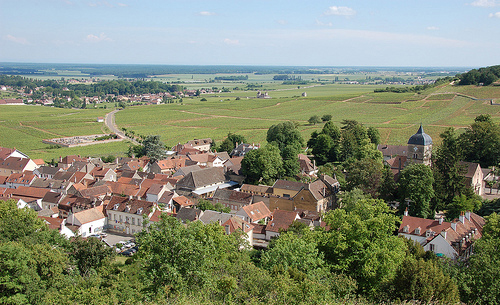
Bonnes Mares is a 15-hectare Grand Cru climat that straddles the border of Chambolle-Musigny (where 13.5 ha are located ) and Morey-St-Denis (the remaining 1.5 ha). The vineyard is situated north of the village of Chambolle-Musigny, and borders the Route des Grands Crus in the east and Clos de Tart in the north. The east-facing vineyard lies on a very gentle slope that varies only between 265 and 300 meters in elevation. Bonnes Mares is bifurcated geologically, with the northern half (the Morey side) – called terres rouges — comprised of heavier soil with a larger component of clay; and the southern half – called terres blanches — comprised of lighter soil, with a greater concentration of rocks and limestone, and containing an abundance of fossilized seashells. The wines coming from the two sections differ considerably, with terres rouges producing more robust and sturdy wines, while the terres blanches wines more delicate  and elegant.  In either case, as Clive Coates has written, the wines are hardly Chambolle-Musigny. Instead Bonnes-Mares is sui generis: wine that is fully-textured, deep, tannic and rich.

The name Bonnes-Mares likely derives from a cloistered order of Cistercian nuns (the good mothers) that lived nearby. A more charming etymology suggests that the name derives from a now-lost bas relief unearthed that portrayed a trinity of Roman goddesses of the harvest whose images protected the vineyard.

Distinguished proprietors of the vineyard include Comte Georges de Vogüé, J-F. Mugnier, Vougeraie, and Georges Roumier.
Read Full Post »


Chambolle-Musigny


 Chambolle-Musigny is a wine appellation that includes some of the finest French Burgundy wine. Wine so labeled must come from vines planted in the commune of Chambolle-Musigny, which is situated in the Côte de Nuits region of the Côte-d’Or department in Burgundy in eastern France.

Chambolle-Musigny is a generally square-shaped commune lying  between Vougeot to the north and Morey-Saint-Denis to the south. The Grône River, flowing southeasterly, bisects the commune as it runs from the heights above the village through a natural valley (“combe”) toward the RN 74. Two slopes  rise from the river valley at either end of the commune. The name “Chambolle” derives from the Latin campus ebulliens, or boiling field (champ bouillant), which was apparently descriptive of the Grône when swollen and overflowing its banks into the adjoining fields after a rainstorm.

The commune does nor appear to have been settled in antiquity and first emerges in the historical records around 1110 as “Cambolla,” a vineyard area run by the ubiquitous monks of Citeaux. From the early 14th century until the early 16th century, Chambolle was a vicarage of Gilly-les-Citeaux.

The vineyards of Chambolle-Musigny occupy 180.31 ha, of which 94.69 produce village-level Chambolle. There are 61.36 ha  of premier cru Chambolle divided among 24 different climats, although only a few of these are well known. The best known is Les Amoureuses, which is essentially a Grand Cru in all but name. The best of the rest include Les Charmes, Les Fuées and Les Cras. There are 24.24 ha in Chambolle that contribute to the commune’s two Grands Crus, Musigny and Bonnes Mares. Virtually the entire production of the commune is red. Only one tiny and rare cuvée of white, Le Musigny blanc from Comte Georges de Vogüé.

Chambolle-Musigny is unique in the Côte de Nuits for the chalky composition of its soils (unlike the clay soils prevalent elsewhere). The thin, calcareous layer clings to a hard rocky soil beneath, which stresses the vines and sharply restricts their yield.  These soils are largely responsible for Chambolle-Musigny’s exceptional delicacy and finesse.  

The most respected sources of fine Chambolle-Musigny include Domaine Comte Georges de Vogüé, Domaine J-F. Mugnier, and Domaine Georges Roumier.

Read Full Post »

          Aux Cras is a 3-hectare Premier Cru climat in Nuits-St-Georges. The vineyard is situated in the portion  of Nuits closest to Vosne-Romanée and lies just south of Aux Boudots and downhill from Les Damodes. Not surprisingly for a vineyard whose name derives from a word meaning “rocky,” the soil is dominated by brown limestone and gravel over a pink Comblanchien limestone base.  The vineyard faces east from an elevation of 250-270 meters.

Read Full Post »

          Les Chaumes is a 6.46-hectare Premier Cru vineyard situated in the commune and appellation of Vosne-Romanée , which is located in the Côte de Nuits sector of  Burgundy.  Les Chaumes lies immediately downslope from Aux Malconsorts and La Tâche,  and adjacent to the border with Nuits-St-Georges,  as the hill levels out heading toward Route National-74. The soil is accordingly a little richer and deeper and with a somewhat higher proportion of clay. The vineyard faces East from an elevation of about 250 meters.

The word chaumes is related to the word charmes, derives from the Latin calmis and  means field or pasture.

A superb example of Les Chaumes is made by Louis-Michel Liger-Belair at Domaine du Comte Liger-Belair.

Read Full Post »

               Les Petits Monts is a small 3.67 hectare Premier Cru vineyard in Vosne-Romanée that lies above Richebourg. Facing east, northeast from elevations ranging between 280 and 340 meters, the soil is quite rocky. The origin of the name is straightforward and suggests only the size (petit=small) of the hill on which the vineyard is situated.

Read Full Post »

               Aux Brûlees is a 4.53 hectare Premier Cru vineyard in Vosne-Romanée that lies just  to the north of Les Veroilles ou Richebourgs. Facing south from an elevation averaging 280 meters,  the soil is mostly hard limestone. The origin of the vineyard name, which means burnt in French, is consistent with the hot, southern exposure. Alternatively, it could suggest that the vineyard was originally burned as a means of clearing it for viticulture.

Read Full Post »

Les Suchots is a 1.62 hectare Premier Cru  vineyard  in Vosne-Romanée that lies immediately north and level with Romanée-St-Vivant.  The elevation of Les Suchots ranges between 250 meters and 270 meters. Facing east southeast, the topsoil is deep and very rich in clay and lies over a base of limestone. The etymology of Suchots likely relates to a regional slang word for hillock.

Fine examples of Les Suchots are produced by Sylvain Cathiard, Louis-Michel Liger-Belair and Robert Arnoux.

Read Full Post »

Aux Reignots is a small 1.62-hectare Premier Cru vineyard in Vosne-Romanée  that lies on a steep 15% slope above  iconic Grands Crus La Romanée, La Tâche, and La Romanée-Conti. The elevation of Aux Reignots ranges between 280 and 320 meters with an exposition toward the east. This vineyard has a very sandy topsoil over a limestone base.

Many connoisseurs contend that Aux Reignots, along with Aux Malconsorts,  consistently produces Grand Cru level wine. Superb examples of Aux Reignots derive from Domaine du Comte Liger-Belair and Domaine Sylvain Cathiard.

Read Full Post »

           Echézeaux is a 37.69 hectare Grand Cru vineyard situated in the commune of Flagey-Echézeaux  (which is viticulturally joined with Vosne-Romanée). It lies upslope of the Clos de Vougeot and wraps around Grands-Echézeaux on the latter’s southern and western sides; and is bordered by Chambolle-Musigny on its north. One of the largest Grand Cru vineyards in Burgundy, Echézeaux is itself comprised of  different lieux-dits: En Orveaux, Les Champs Traversins, Les Poulaillères, Les Rouges-du-Bas, Les Echezeaux-du-Dessus, Les Loachausses, Les Criots-en-Vignes-Blanches, Clos St-Denis, Les Treux, Les Quartiers de Nuits

            The name “Echézeaux” derives ultimately from the Latin casalis meaning a rural house. Casalis was Gallicized to chesal which was pluralized into chesaux. In time, les chesaux became Echézeaux. The ealiest mention in official records was in 1287. The vineyard was acquired by the Abbot of Citeaux in 1353, in exchange for  3 livres tournois (“Tour pounds”) plus some vineyards in Chambolle.

            Echézeaux faces east from an elevation that reaches 300 meters at the top and 260 meters down below. The  slope varies from 10% at the base to 13% at the top. The soil, not surprisingly for such a large vineyard, varies significantly. In general, the base is Bajocian limestone and the soil is silty with considerable gravel and rocks. At the lower and flatter elevation, the soil is richer with a higher component of clay.

            Domaine du Comte Liger-Belair has two parcels of Echézeaux, the first a .4 ha. piece in Les Criots-en-Vignes-Blanches, and the second a .2 ha piece in Les Champs Traversins.

Read Full Post »

La Romanée, Grand Cru: This diminutive .85 ha. Grand Cru climat in Vosne-Romanée is the smallest Grand Cru in the Côte-d’Or and the smallest appellation contrôlée in France. Arguably one of the finest vineyards in France, the poet Gaston Roupnel extolled La Romanée as “La perle du milieu dans le collier bourguignon“ (loosely, “the central jewel of the Burgundian necklace”).  It lies just to the west and uphill from La Romanée-Conti, to the south of Les Richebourgs and to the north of La Grande Rue. It was originally a part of La Romanée-Conti, belonging to the Croonenbourg family from the Fifteenth Century until it was partitioned off in 1760 and sold to the Prince de Conti. A monopole, La Romanée has belonged to the Liger-Belair family since 1815. It was the only major vineyard retained by the family when the remainder of its holdings were auctioned off in the 1930’s. Facing east, the vineyard lies on a steep 16% slope at an elevation of about 280 meters. The subsoil is friable Prémeaux limestone; the topsoil is a sandy-clay mixed with pebbles. Under the skilled and sensitive direction of Louis-Michel Liger-Belair, the wines of La Romanée are said once again to rival in quality the iconic vineyards, La Tâche, and La Romanée-Conti.

Read Full Post »

« Newer Posts - Older Posts »