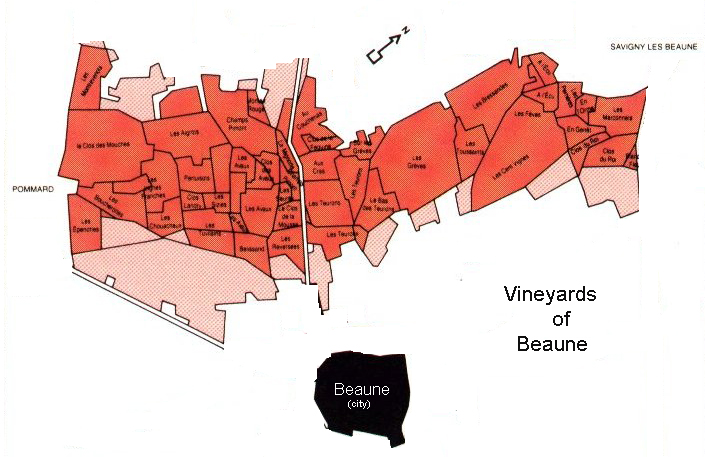
Les Perrières is a small 3.20 ( only 2.98 cultivated) hectare Premier Cru climat within the Beaune appellation in Burgundy’s Côte de Beaune. The vineyard is situated in the northernmost sector of the appellation, uphill and to the west of the Premier Cru Les Marconnets, and somewhat downhill and to the east of the Premier Cru Les Bressandes. The name of the vineyard may indicate that an ancient quarry was located there. Facing southeast from a steep slope varying between 250 and 300 meters, the rocky soil is a mixture of clay and limestone.
Archive for the ‘Appellations’ Category
Vineyard Description: Beaune, LES PERRIÈRES, Premier Cru
Posted in Appellations, Burgundy, Vineyards, Wine on April 20, 2010| Leave a Comment »
Vineyard Description: Beaune, LES GRÊVES, Premier Cru
Posted in Appellations, Burgundy, Vineyards, Wine on April 20, 2010| Leave a Comment »
Les Grêves is a large Premier Cru climat within the Beaune appellation in Burgundy’s Côte de Beaune. At 31.33 hectares, it is, in fact, the largest Premier Cru in the appellation, and most certainly among the finest. Named by Dr. Lavalle (History and Statistics of the Cote d’Or) in 1855 as a “Tête de Cuvée”, Clive Coates writes that the vineyard produces “Beaune at its most elegant, fullish but properly round, rich and balanced, with plenty of depth.” The vineyard name derives from the observed presence of gravel in the soil. Les Grêves is bordered on the south by Sur-les- Grèves and Les Teurons and, on the north, by Les Bressandes and Les Toussaints. Facing east from an elevation varying between 230 and 300 meters, the soil is generally light with a sand and gravel mix, with a somewhat higher proportions of clay uphill.
A parcel of Les Grêves enjoys the lieu-dit La Vigne de l’Enfant Jésus. This parcel belonged to the Carmelite order in the 17th century, when a nun predicted the birth of the future Louis XIV even though his mother, Anne of Austria (who was actually Spanish) was believed sterile. At 37 years of age, Anne’s pregnancy was considered “a marvel.” La Vigne de l’Enfant Jésus belongs today to Bouchard Père et Fils. Other notable parcels of Les Grêves belong to Domaine Lafarge and Domaine de Montille.
Appellation Profile: Beaune
Posted in Appellations, Burgundy, Wine, tagged Beaune, Bouchard Père et Fils, Domaine de Montille, Domaine Lafarge, Julius Caesar, Maison Joseph Drouhin, Vercingetorix on April 15, 2010| Leave a Comment »
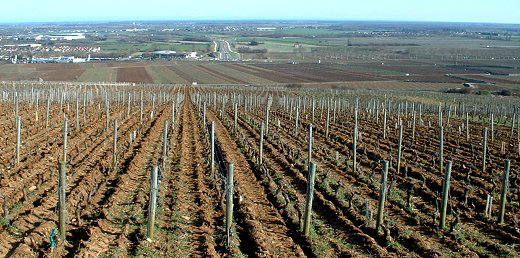
Beaune AOC, looking North From Clos des Mouches
Beaune is a wine appellation that produces high quality Burgundy from vines planted in the commune of Beaune situated in the Côte de Beaune region of the Côte-d’Or. The city of Beaune itself is the second largest (after Dijon) in France’s Burgundy department.
By tradition, Beaune was founded about 52 B.C. as a camp for Julius Caesar’s army as it prepared to defeat the Gaul’s legendary hero Vercingetorix. The name “Beaune”  derives, according to Clive Coates, from Belno Castrium, which would have referred to a fortified small villa. By 1602, Beaune was being referred to in a contemporary map as “Belna (commonly called Beaulne)”.
During the Gallo-Roman period, Beaune served as a way station along the road to Autun, then the capital of Burgundy. As the importance of Autun diminished, first following its conquest by the sons of Clovis in 532, and later after its sacking by the Saracens around 730, Beaune began to emerge as an urban entity in its own right. Formally chartered as a city in 1203, Beaune remained the residence of the Dukes of Burgundy until the late 14th Century, when Phillip the Bold married Margaret of Flanders, and moved the ducal court to Dijon. During the latter part of the Hundred Years war, in 1401, a fire destroyed Beaune. After the Treaty of Arras in 1435, first Louis XI and then Charles XIII, constructed the pentangular castle and massive fortified walls that continue to define Beaune. The Hôtel-Dieu (Hospices de Beaune) was built during that same period under the direction of Phillip the Good, Duke of Burgundy, whose chief claim to fame is that he betrayed Joan of Arc to the rosbifs, who promptly burned her at the stake.
Beaune has been celebrated for its vineyards at least since Gregoire, Bishop of Tours, wrote his history of France (Historia Francorum) in 570. Today Beaune continues to boast some of the finest vineyards in the world. The entire appellation comprises 531 hectares, the majority of which, 337 hectares, is within 44 climats that are, in whole or part, designated Premier Cru. In addition, the appellation consists of 138 hectares of village-level Beaune and 66 hectares from the related AOC Côte-de-Beaune.
The vineyards are situated on gentle slopes northwest of the city and thus enjoy, in general, favorable southeastern exposition. The sloping hillside on which the Premiers Crus lie, begins at the border with Pommard and extends in a northerly direction until it meets the border of Savigny-lès-Beaune. The vineyards are bisected by the N470 as it crawls up the hill toward Bouze-lès-Beaune. Most critics believe that the best section lies to the north of this road, where the soils are a mix of gravel and iron-rich clay over a limestone base. This sector, celebrated even in the 19th Century, includes Les Bressandes, Les Perrières, Les Grèves, and Les Marconnets, and produces the most complex wines of the appellation. Further north of this sector, toward the border with Savigny-lès-Beaune, the soil becomes thinner, especially in the steeper upslope vineyards.
South of the N470, the soil becomes more sandy, and occasionally quite stony. While 95% of Beaune vineyards produce red, Pinot Noir-based Burgundy, a few of the vineyards in this sector, notably the famous Le Clos des Mouches, yield excellent white Burgundy. In the central portion of this sector are found two remarkable vineyards, Les Aigros and Les Sizies, whose sandy, limestone soils give rise to elegant and subtle red Burgundies of a charming, somewhat lighter style. The vineyards downhill from Le Clos des Mouches, tend to flatten out as they extend toward the RN 74, and have deeper soil with a higher proportion of clay. This last sector, known locally as Le Puits de Beaune (“Beaune’s well”), and accordingly suffering from poor drainage and risk of frost, is not a reliable source of fine wine.
The size and wealth of Beaune as a city have resulted in two salient consequences: (1) the high proportion (arguably not fully justified) of Premier Cru climats in the appellation; and (2) the dominance of the large négotiant houses (e.g., Drouhin, Bouchard Père et Fils, Bichot, Patriarche) headquartered in the city, within the ownership and politics of the appellation. Although a couple of these négoces do in fact produce exemplary wines from the Beaune AOC (Bouchard’s Vigne De L’Enfant Jésus, from a lieu-dit within Les Grèves, and Drouhin’s Clos des Mouches), the preponderance their wines have contributed to the unfortunate and lackluster reputation of the appellation. Not surprisingly, some of the finest wines from Beaune come from Domaines originating in other appellations but with small holdings in Beaune: Domaine de Montille ( Les Grèves, Les Sizies, Les Aigros, Les Perrières), Domaine Lafarge (Les Grèves, Les Aigros).

Vineyard Description: Volnay, LES MITANS, Premier Cru
Posted in Appellations, Burgundy, Vineyards, Wine, tagged Domaine de Montille, Etienne de Montille, Lafarge, Michel Lafarge, Volnay on April 10, 2010| Leave a Comment »
Les Mitans is a 3.98-hectare Premier Cru climat in Volnay. The vineyard downhill, just to the southeast of the Autun Road (RN73) between Premiers Crus Les Brouillards and En L’Ormeau. “Mitans” means “between”. The vineyard is mostly clay-limestone, very stony, and enjoys an elevation of 250-260 meters and an exposition of east, southeast.
Vineyard Description: Volnay, CLOS du CHÂTEAU des DUCS, Premier Cru
Posted in Appellations, Burgundy, Vineyards, Wine, tagged Domaine Lafarge, Michel Lafarge, Volnay on April 10, 2010| Leave a Comment »
Clos du Château des Ducs is one of several Premier Cru climats in Volnay collectively known as Le Village but also entitled to their own individual Premier Cru liux-dits. Clos du Château des Ducs, a tiny .57-hectare monopole of Domaine Michel Lafarge, lies below the village of Volnay , just above Clos de la Chapelle and Clos de la Bousse d’Or. As the name suggests, this vineyard lies on the site of the 11th century Château de Volnay, which was owned by the Ducs of Burgundy from the 13th century onward. The Château itself was destroyed by fire in 1749, but its vineyards, as well as the cellars originally belonging to the Château, now belong to Domaine Michel Lafarge. Facing east, southeast, the vineyard lies at an altitude averaging 280 meters. The soil is a light-colored mixture of clay and Oxfordian (“Argovian”) limestone.
Vineyard Description: Volnay, LES CAILLERETS , Premier Cru
Posted in Appellations, Burgundy, Vineyards, Wine, tagged Clos des Chênes, Domaine Michel Lafarge, Marquis d'Angerville., Volnay on April 10, 2010| Leave a Comment »
Les Caillerets is a 14.33-hectare Premier Cru climat in Volnay. The vineyard is situated downhill from Clos des Chênes, just southeast of the Autun Road (RN 73). It is among the most renowned in Volnay, producing, as Clive Coates writes, “Volnay of real silk, lace and the complexity of all the petits fruits rouges you can imagine.” Facing east, southeast from an altitude varying between 260 and 290 meters, the rocky soil of Les Caillerets is an admixture of limestone and calcium- rich clay. Fine examples of Volnay, Les Caillerets are made by Domaine Michel Lafarge and Domaine Marquis d’Angerville.
Vineyard Description: Volnay, CLOS des CHÊNES, Premier Cru
Posted in Appellations, Burgundy, Vineyards, Wine, tagged Clos des Chênes, Clos du Château des Ducs, Domaine des Comtes Lafon, Domaine Michel Lafarge, Dominique Lafon, Les Caillerets, Les Santenots-du-Milieu, Les Taillepieds, Volnay on April 7, 2010| Leave a Comment »
Volnay, Clos des Chênes is a 15.41-hectare Premier Cru climat in Volnay. Clos des Chênes is situated in the southern end of Volnay, above Route Nationale 73 at the border with Monthélie. The name attests to the onetime presence of an ancient oak forest on the vineyard site. At one time the vineyard belonged to the Knights Templar, but was later inherited by the Brotherhood of the Holy Sacrament. Clos des Chênes faces southeast from an altitude of between 280 and 320 meters, with soil composed of limestone marl and clay-limestone scree. Along with Les Caillerets, Les Taillepieds, Clos du Château des Ducs, and Les Santenots-du-Milieu, Clos des Chênes is ranked among the best in the appellation. Excellent Clos des Chênes is produced by Domaine des Comtes Lafon and Domaine Michel Lafarge.
Vineyard Description: Volnay, LES SANTENOTS-DU-MILIEU, Premier Cru
Posted in Appellations, Burgundy, Vineyards, Wine, tagged Domaine des Comtes Lafon, Domaine Mikulski, Dominique Lafon, François Mikulski, Volnay. Meursault on April 7, 2010| Leave a Comment »
Volnay, Santenots-du-Milieu is a 22.36-hectare Premier Cru climat situated within the appellation Santenots. Santenots is physically located within the commune of Meursault (although adjacent to Volnay), but is by law entitled to use the appellation Volnay, Santenots. Thus, although the vineyards are actually in Meursault, the wines are entitled to be called Volnay. The reason for this apparent anomaly is that the red clay soil in Santenots has long been viewed as better suited for Pinot Noir than Chardonnay, and the appellation Volnay is much better known for red Burgundy than is Meursault.
The best section of Santenots is Santenots-du-Milieu, having been classified by Dr. Lavalle as tête de cuvée. At an elevation of 240-280 meters, Santenots-du-Milieu faces southeast on soil shallow, red, heavy clay soil, above a subsoil of Bathonian limestone. The wines are deep in colour, rich and sturdy, with deep tannins , and, if somewhat lacking in the elegance of characteristic of the best Volnay, is lush and supple.
Excellent examples of Santenots-du-Milieu are made by Domaine Mikulski and Domaine des Comtes Lafon. In fact, the parcels of these two winemakers formed a single vineyard in the first part of the twentieth century until it was split and sold off to the grandfathers of Franςois Mikulski and Dominique Lafon.
Vineyard Description: Meursault, CLOS DE LA BARRE (Monopole)
Posted in Appellations, Burgundy, Vineyards, Wine, tagged Comtes Lafon, Domaine des Comtes Lafon, Dominique Lafon, Meursault on April 7, 2010| Leave a Comment »
Meursault, Clos de la Barre is a village-level 2.12-hectare monopole of the Domaine des Comtes Lafon in Meursault. The lieu-dit Clos de la Barre is comprised of a vineyard entirely enclosed within the walls of the Domaine, where the family home is situated, at the northern edge of the town of Meursault. The gently-sloping and east-facing vineyard is planted in three parcels, the first (.8 hectare) planted in 1950, the second (.8 hectare) in 1975, and the third (.5 hectare) replanted in 2004. The soil is an admixture of clay and marl over a hard limestone base. The Chardonnay-based wines of Clos de la Barre rich with pronounced minerality and a crisp finish.
Vineyard Description: Meursault, DESIRÉE (Monopole)
Posted in Appellations, Burgundy, Vineyards, Wine, tagged Comtes Lafon, Domaine des Comtes Lafon, Dominique Lafon, Meursault on April 7, 2010| Leave a Comment »
Meursault, Désirée is a village-level .45-hectare monopole of the Domaine des Comtes Lafon in Meursault. Desirée is actually situated in Les Plures, a Premier Cru climat situated at the northern part of Meursault, and could, accordingly, be bottled as Meursault, Les Plures, Premier Cru. Nevertheless, Dominique Lafon has chosen to label the wine simply as “Desirée” (an old cadastral name) both out of a sense of tradition and because he does not think that the wines warrant Premier Cru designation. East facing, Les Plures is rich in red clay, not very deep, and well-suited to the Pinot Noir which produces the Volnay Santenots which predominates in the vineyard. Lafon plants Desirée entirely with Chardonnay, however, and crafts an atypical Meursault that is seductive, slightly spicy, and rather exotic.
.
 Jockovino