Les Evocelles: This 10.44-hectare climat is situated in the commune of Brochon but is entitled to the AOC Gevrey-Chambertin. The vineyard is located high up the hill at the northwesterly-most point in viticultural Gevrey. The name derives from a corruption of Les Broselles, referring to a patch of scrubland. All of the adjacent and neighboring vineyards are designated Premier Cru. Les Evocelles enjoys a favorable south, southeast exposition and lies on the same calcareous soil as its neighboring Premiers Crus Champeaux and Combe aux Moines. While it is unclear why Les Evocelles missed out on the more prestigious denomination, arguably the high elevation of the vineyard, at almost 400 meters, occasionally affects the ripeness of the grapes in cool vintages. An excellent source is Domaine de la Vougeraie.
Archive for the ‘Burgundy’ Category
Vineyard Description: Gevrey-Chambertin, LES EVOCELLES
Posted in Appellations, Burgundy, Vineyards, Wine, tagged Domaine de la Vougeraie on May 5, 2010| Leave a Comment »
Vineyard Description: Gevrey-Chambertin, LA JUSTICE
Posted in Appellations, Burgundy, Vineyards, Wine, tagged Domaine de la Vougeraie on May 5, 2010| Leave a Comment »
La Justice: This 18.27-hectare climat in Gevrey-Chambertin is itself comprised of two subclimats of approximately equal size. The downhill subclimat is rich in alluvial gravel whereas the uphill parcel has very thin topsoil. The vineyard lies to the east of the town at a hollow in the hill that has benefited over the millenia from the alluvial flow of diverse minerality. By tradition, the name of this vineyard derives from its function in years past as a place where executions by hanging and guillotine were carried out. It beggars credulity, however, to suppose that the blood of aristocrats beheaded following the French Revolution can have much enriched the terroir and its wines. There are numerous owners of this vineyard although the most consistent source of elegant and concentrated wines comes from the Domaine de la Vougeraie.
Vineyard Description: Gevrey-Chambertin, LATRICIÈRES-CHAMBERTIN, Grand Cru
Posted in Appellations, Burgundy, Vineyards, Wine on May 5, 2010| Leave a Comment »
Latricières-Chambertin, grand cru : This 7.35-hectare Grand Cru climat, situated in the commune of Gevrey-Chambertin, is comprised of two subclimats, Latricières at 6.90 hectares, and Aux Combottes at .45 hectares. The vineyard lies at the southern end of the commune, at the border with Morey-St-Denis, to the west of Chambertin and waet (uphill) of Charmes-Chambertin. Facing east from an altitude of 280 meters, the vineyard lies over a limestone base with topsoil consisting of a crumbly mixture of clay, silt and limestone.
The name of the vineyard derives from “la tricière”, old Burgundian argot for a worthless parcel of land unsuited for agriculture. There are nearly fifteen separate owners of the vineyard.
Vineyard Description: Gevrey-Chambertin, CHAPELLE-CHAMBERTIN, Grand Cru
Posted in Appellations, Burgundy, Vineyards, Wine on May 5, 2010| Leave a Comment »
Chapelle-Chambertin: This 5.48-hectare Grand Cru climat, situated in Gevrey-Chambertin, is comprised of two subclimats, En la Chapelle at 3.69 hectares, and Les Gémeaux at 1.79 hectares. Both abut the RN 74, just east and downhill from Clos-de-Bèze. Facing east from a gentle slope lying at 260 meters, the vineyard’s soil is shallow and pebbly on top of a Bajocian limestone base.
The name of the vineyard recalls a chapel built on the site by the monks of Bèze in 1155.
Vineyard Description: Gevrey-Chambertin, CHARMES-CHAMBERTIN (including MAZOYÈRES-CHAMBERTIN), Grand Cru
Posted in Appellations, Burgundy, Vineyards, Wine on May 5, 2010| Leave a Comment »
Charmes-Chambertin (including Mazoyères-Chambertin). If Chambertin and Clos-de-Bèze are the undisputed kings of Gevrey-Chambertin, just so is Charmes-Chambertin the undisputed crown prince. At 30.83 hectares, Charmes-Chambertin, a Grand Cru climat in Gevrey-Chambertin, is more than twice the size of any other Grand Cru in the commune. Charmes-Chambertin is comprised of two lieux-dits, Aux Charmes at 12.25 hectares, and Mazoyères at 18.58 hectares. Both climats may be bottled as Charmes-Chambertin, and usually are. Wine from Mazoyères, however, may also be bottled as Mazoyères-Chambertin, or as Charmes-Chambertin, Les Mazoyères.
The Charmes-Chambertin vineyard lies south of the Beaune-Dijon Road (RN 74), with the Mazoyères parcel between Latricieres-Chambertin and the RN74; and the Aux Charmes lieu-dit just to the south of Chambertin. The vineyard faces east from an altutude of 260 meters. The base is Bajocian limestone, and the shallow overlying soil consists of decomposed limestone (called lave), clay and gravel.
Of all the Grands Crus of Gevrey-Chambertin, Charmes is the most forward in its development, and provides the easiest drinking, early on. It is also among the most feminine. One is very tempted to call the wine “charming”, which would be an accurate descriptor, but the vineyard name actually derives from the word “Chaume” and refers to the fact that it was at one time a fallow field.

Vineyard Description: Gevrey-Chambertin, CHAMBERTIN, CLOS-de-BÈZE, Grand Cru
Posted in Appellations, Burgundy, Vineyards, Wine on May 5, 2010| Leave a Comment »
Chambertin, Clos-de-Bèze: This 15.40-hectare Grand Cru climat, situated in Gevrey-Chambertin, lies immediately north of Chambertin, and extends north along the western side of the RN 74 until Mazis-Chambertin.
Interestingly, Clos-de-Bèze is actually the oldest vineyard in Gevrey, older even than Chambertin. Following a gift of the vineyard to them by the Duc Amalgaire de Bourgogne, the monks of Bèze planted the vineyards around 630 A.D. Only after Clos-de-Bèze came under the jurisdiction of Cluny around 900 did the monks decide to plant the area now comprising Chambertin. Perhaps it is for this reason that Clos-de-Bèze may legally be sold as Chambertin, Clos-de-Bèze, but Chambertin may not.
Like Chambertin, Clos-de-Bèze faces east from a similar altitude of 275-300 meters. The soil is a mixture of clay-limestone-pebble over a base of Bajocian limestone. The wines from the Clos-de-Bèze are only subtly different from Chambertin, with Clos-de-Bèze perhaps exhibiting a bit more liveliness as well as greater delicacy.
Vineyard Description: Gevrey-Chambertin, CHAMBERTIN, Grand Cru
Posted in Appellations, Burgundy, Vineyards, Wine, tagged Domaine Armand Rousseau. on May 5, 2010| 1 Comment »
Chambertin: This 12.90-hectare Grand Cru climat, situated in Gevrey-Chambertin, is preeminent in the commune and one of the most famous vineyards in the world. It lies to the west of the RN 74, and between Latricieres-Chambertin and Chambertin, Clos-de-Bèze. Facing east on a gentle slope from an altitude of 275-300 meters, Chambertin is well protected from the westerly winds by the forest of the Montagne de la Combe-Grisard, the soil is clay-limestone colluvium mixed with oolitic pebbles over a base of Bajocian limestone.
The wines of Chambertin are among the most powerful and assertive of red Burgundies. In their youth, they are sturdy and full, often a bit austere, but well-structured and loaded with black fruit. As they age, they become rounder, more generous and more complex.
The most respected producer of Chambertin is Domaine Armand Rousseau.
Appellation Profile: NUITS-SAINT-GEORGES
Posted in Appellations, Burgundy, Wine, tagged Domaine de l'Arlot, Domaine de la Vougeraie, Domaine des Perdrix, Domaine Gérard Mugneret, Domaine J-F. Mugnier, Henri Gouges. on May 4, 2010| Leave a Comment »
Nuits-St-Georges is a wine appellation that includes some of the finest and best-known French Burgundy wine. Wine so  labeled must come from vines planted in the commune of Nuits-St-Georges (or the adjoining commune of Prémeaux-Prissey with which it is viticulturally joined) situated in the Côte de Nuits region of the Côte-d’Or department of Burgundy in eastern France.
In From the Earth to the Moon, author Jules Verne envisioned in 1867 that the first lunar explorers would celebrate their moon landing with “a fine bottle of Nuits.” In 1971, to commemorate Verne’s sci-fi forecast, Apollo 15 astronauts named one of the moon’s craters “St. George Crater”. Completing the circle, the town council in Nuits-St-Georges rechristened the main square in the village Place de la Cratère. The vineyards of Nuits-St-Georges, celebrated by Verne and Apollo 15, have been successfully producing wine of the first rank for at least one thousand years.
Leaving Beaune and heading north toward Dijon, Nuits-Saint-Georges marks the gateway of the Côte-de-Nuits, the Oz of Pinot Noir. The commune has been inhabited since antiquity and the vestiges of a substantial Gallo-Roman villa have recently been excavated. The name “Nuits” is derived from the Latin “nutium,” signaling the fine walnuts that were once prolific in the area.
Nuits St Georges, together with Prémeaux-Prissey, comprises 322.59 hectares. While there are no Grands Crus, there are 37 Premiers Crus aggregating about 147 hectares, and about 175 hectares of village-level vineyards. The overwhelming majority of vines, some 97%, are planted in Pinot Noir, from which prized red Burgundy is made, but there are a few vines planted in Chardonnay from which a small group of domaines, notably Domaine J-F. Mugnier and Domaine de l’Arlot, produce excellent Nuits-Saint-Georges blanc.

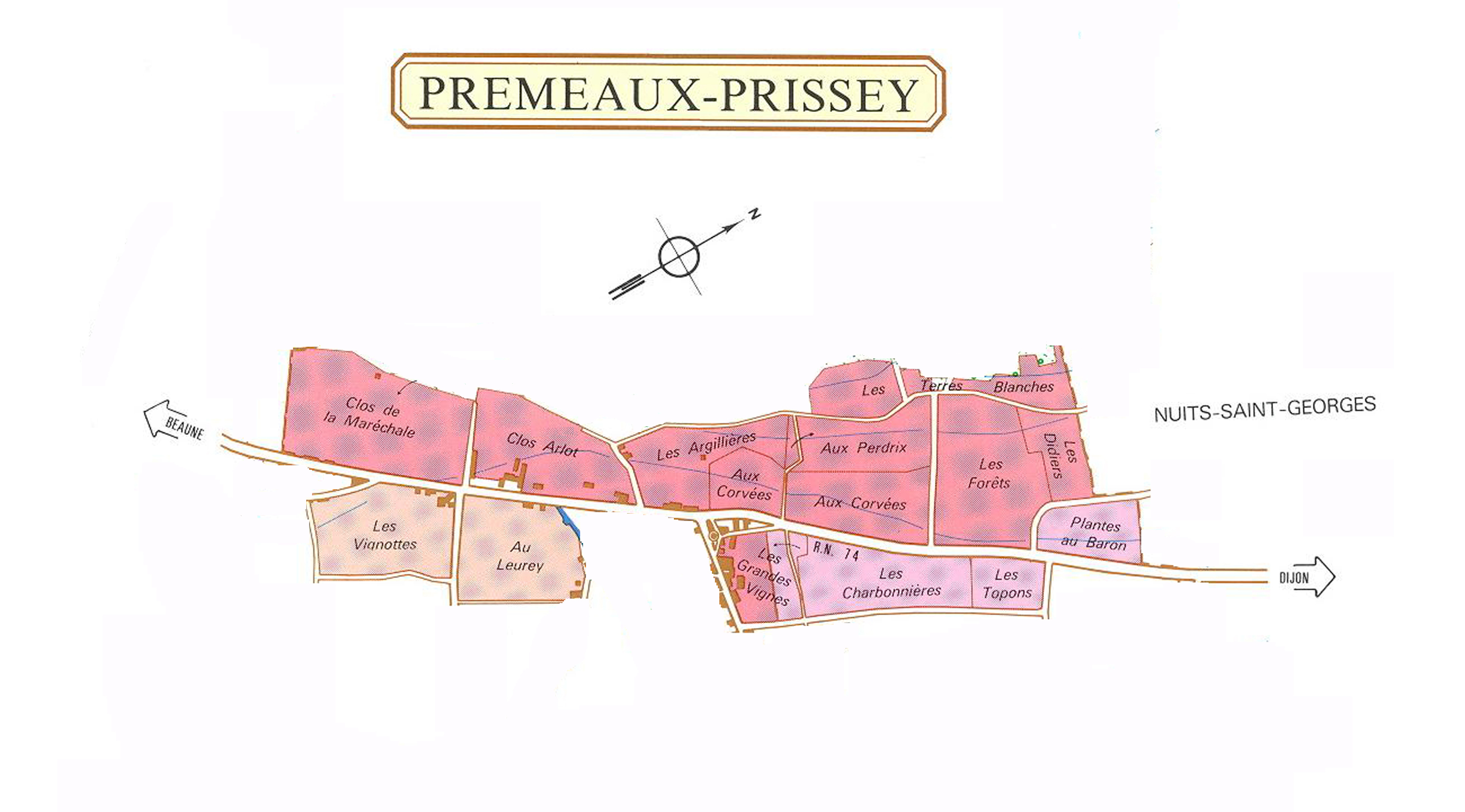
The soil types fall into three sections. The town and the vineyards are bisected by the Meuzin River, which flows east from the hills above the town. North of the river, toward Vosne, lies the first section. There, the soil is a continuation of Vosne: colluvium comprised of limestone with a small amount of clay over a Bathonian limestone base, and covered with pebbles and scree. Most prominent among these vineyards are Aux Boudots, Les Thorey and Les Damodes.
To the south of the Meuzin River, toward Beaune, lies the second section. Here the soil is somewhat richer and deeper, certainly with a higher clay content, but also with sand and gravel. The base here is comprised mostly of hard Comblanchien limestone. Most prominent here is the commune’s signature vineyard, Les Saints Georges. Further south, and within Prémeaux-Prissey, is found the third section, in a higher elevation, reaching 320m. Here the soil is quite thin and fine, particularly in the Clos de l’Arlot. Further downslope can be found Clos de Forêts and Clos de la Marechale.
Leading producers in the appellation include Domaine de l’Arlot for its Clos de l’Arlot and Clos des Forêts, Domaine J-F. Mugnier for its Clos de la Marechale, Domaine de la Vougeraie for its Les Damodes, and Domaine Gérard Mugneret for its Les Boudots. Other well-known Domaines include Domaine des Perdrix and Henri Gouges.
Vineyard Description: Nuits-Saint-Georges, CLOS des GRANDS VIGNES , Premier Cru
Posted in Appellations, Burgundy, Domaines, Vineyards, Wine, tagged Château de Puligny-Montrachet on May 4, 2010| Leave a Comment »
Clos des Grandes Vignes: This 2.21-hectare Nuits-St-Georges Premier Cru climat is a monopole of the Château de Puligny-Montrachet. The walled vineyard lies on the east side of the Beaune-Dijon road (RN 74) in the middle of the commune of Premeaux-Prissey. Facing east and lying at 230-240 meters, the soil is nearly flat with only a 2-4% slope. The topsoil is a mixture of limestone with a small amount of clay and the subsoil is Bathonian limestone.
Vineyard Description: Nuits-Saint-Georges, LES THOREY, Premier Cru
Posted in Appellations, Burgundy, Vineyards, Wine, tagged Domaine de Montille, Domaine Sylvain Cathiard on May 4, 2010| Leave a Comment »
Les Thorey: This 5-hectare Premier Cru climat lies in the northern part of the commune of Nuits-St-Georges, uphill and to the north of the village. Facing southeast and lying at 225-280 meters, this vineyard lies just above Aux Bousselots on a slope of 10-15%. The topsoil is a mixture of limestone and clay over a base of Comblanchien limestone. Two superb examples of Les Thorey come from Domaine Sylvain Cathiard and Domaine de Montille.
 Jockovino
